The possibility of "testing on the spot" is important, because first of all, it is what helps you discover that the very notion exists.
From the experimental archaeology session in this video, we won't hesitate :-) to assert that rattlebacks were discovered, by primitive human species, millions of years ago, on exceptional beaches, just like the one pictured in the video (Crovani / Argentella beach, Corsica).
Beaches of this type were probably few in number: you need to find absolutely smooth pebbles.
But over millions of years of evolution, no doubt :-) that, multiple times, our most primitive ancestors, made this discovery, while playing on one of those beaches, during their childhood :-)
Chartres Labyrinth - How many different versions can we create ?
I recently stumbled upon a famous labyrinth in Chartres (France), 12th century.
At first sight, Chartres Labyrinth is amazing. You can't immediately figure out how it works (entrance, exit, path, dead ends, ...). It appears on the paved floor of a religious building. When I was there, the labyrinth was visible under numerous chairs installed on the floor. In those circonstances, you try to follow the path of the labyrinth with your eyes, from a distance. But its concentric circles have a puzzling visual effect. You need to follow it for real, on foot.
After a while, trying to follow the path, avoiding the chairs, it appears that it is not a maze : it has only one path, no dead ends, the entrance and the exit are the same. The specialists use the term "unicursal".
Then a question arise : how many of those labyrinths can you create, following the same design and rules (more or less). If there are more than one solution, why choose this particular one.
This question can take a bit of time.. I guess mathematicians know the answer.
I finally managed (hardship with design softwares...) to produce some variants of the Chartres Labyrinth. There seem to be a lot more...
That could be the subject of a playful hoax : flooding the internet with images of alternative versions of the Chartres Labyrinth, and see if people get caught. Am I just trying that here, on a modest scale ?
Some alternative versions to the Chartres Labyrinth - 4 sectors - 11 circuits
this one has a small dead end and a short straight path that is an island ;
not perfect, because all the surface is not used
This one has 2 small dead ends : we should avoid that
this one contains a closed curved path that is an "island" (in the middle of the down right quarter) :
an example of what we should certainly avoid
this one is better, but still has a small dead end, and a straight island
this one is cool... only 2 small dead ends
but several branches to and from the central trunk
Same version, but without the dead end
Some alternative versions, Chartres-like Labyrinths - 5 sectors - 11 circuits
Not that bad, with five lobes, one dead end here
Two small dead ends, here
Same as before, but without the dead ends,
feels a bit unbalanced ?
Chartres like Labyrinth carved on a Tagua nut - finger labyrinth - hypnoglyph
The same labyrinth as before, carved on a Tagua nut,
to be used as a finger labyrinth
Chartres like Labyrinth drawn on a spherical surface - Potato
Another 5 lobes labyrinth, wrapped onto a potato :
The same version as before, after a transposition (by different method than for the potato) on the surface of a dodecahedron.
There, each circuit/level is represented by one face of the dodecahedron, among eleven of those. The last face represents the inner and the outer space (center and outside of the Chartres-like labyrinth). Each lobe, and each of the two central paths of the Chartres-like Labyrinth (the entry and arrival at the centre) is represented by a lane in which the path will be followed.
Here a video silently illustrating (or just suggesting) the process of transposition :
Another Chartres like Labyrinth carved on a Tagua nut - finger labyrinth - hypnoglyph
The next 5 lobes, 11 circuits Chartres-like labyrinth I'll make will be this one :
here, carved on a rather angular tagua nut
Computer program generated Chartres-like Labyrinths - javascript - Google Script
June 10, 2020 - I finally wrote my own prototype of a labyrinth generator computer program... it's still imperfect, limited by my incompetence and by some restrictions of the tools i could use (exploration with Google script + rendering in html and javascript). With Google script, despite the 6 minutes limit of running time, the whole exploration is possible for 11 circuits and 5 sectors (with some pruning to avoid disgraceful labyrinths)... but not all of the output via the log (don't know how to write elsewhere, yet). For the rendering, I've some improvements to do...
Some of the 42300 labyrinths found by the computer program
See here, 1 in 150 of the more than 42300 labyrinth the computer program has found. :
See how the technique used (canevas, in html) draws labyrinths that are more "decayed" when drawn farther from the origin.
click on the video below...
More info found : what other people had been doing...
Blogmymaze - Andreas Frei
April 10, 2020 - I find a blog, BLOGMYMAZE ( https://blogmymaze.wordpress.com ), that explores labyrinths, and examines a few cases of "11 circuits, 4 sectors" labyrinths :
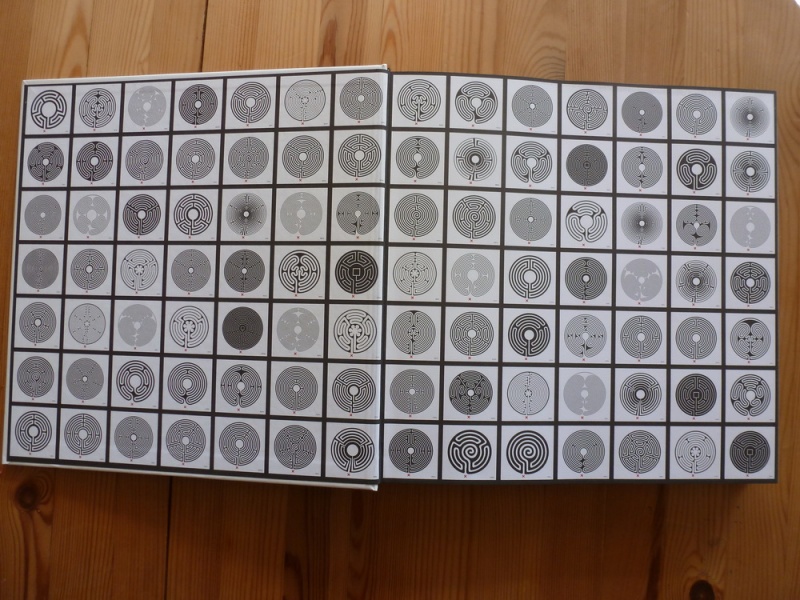
April 10, 2020 - Someone has already done this kind of work extensively : in 2013, Mark Wallinger, British artist, has shown 270 distinct labyrinths, one in each of London tube station. There was also a catalog of that; see for instance :
May 8, 2020 - An interesting blog compares existing (or having existed) mazes similar to the Chartres Labyrinth. It uses the rectangular transcription to ease the comparison.
Caerdroia - Labyrinthos - Andreas Frei, Hellen Galo, Tristan Smith, Jacques Hébert, ...
May 24, 2020 - Publications n°33 to n°39 of "Caerdroia - the Journal of Mazes & Labyrinths" are available in PDF versions on http://www.labyrinthos.net/digitaldownload.html. Particularly, among many other things, you'll see articles about :
- some variants of Chartres-like labyrinths, explanation from Andreas Frei about his way of cataloging labyrinths, in Caerdroia 39 (links to his website, in German, that seems rather empty) ;
- Amerindian mazes, in Caerdroia 38 ;
- how to create perfect labyrinths(Frei's graph + Hébert notation + 6 canonical labyrinths),by Ellen Galo, in Caerdroia 37 ; this article is also available in the archive of the most requested past articles... so... the subject is clearly interesting to a fair number of people :-)
- Kota labyrinths in southern India, in Caerdroia 36 ;
- how to analyze, design and scale up chartres-like labyrinths, by Andreas Frei, in Caerdroia 35 ;
- a computer program for generating medieval labyrinths, by Tristan Smith, in Caerdoia 35; we read that without enforcing strict enough rules about the properties of the labyrinths, there is ~5 million versions of a 11 circuits / 4 sectors labyrinth. The article links to Tristan Smith's website, where a good number (rapid count : more than 130) of alternative versions of Chartres-like labyrinths have been generated by the program (or with its help), using strict enough rules. The set of rules of Jacques Hébert gives just 20 "canonical labyrinths" that would be (i guess) the most "Chartres-like".
Also, the definitions corresponding to the rules that the program can respect are here https://www.otsys.com/~tsmith/properties.html(but the article in Caerdrioa is clearer : shows examples)
- a mathematical notation for medieval labyrinths, by Jacques Hébert, in Caerdroia 34;
surprise... Andreas Frei is actually also one of the authors of the blog Blogmymaze (see higher)...
The most requested past articles of Caerdoia are made available in the archive
Developing the Labyrinth: Alex Champion, p.43-51: re-drawing the classical labyrinth - new variants.
#34 (2004, pdf online)
A Mathematical Notation for Medieval Labyrinths, p.37-43: Jacques Hébert explains.
#35 (2005, pdf online)
The Cascading Serpentine, p.19-26: Andreas Frei examines the Chartres labyrinth structure.
#35 (2005, pdf online)
A Daedalus for the 21st Century, p.27-33: Tristan Smith’s software labyrinth builder.
#37 (2008, pff online)
Sigmund Gossembrot’s Labyrinth: A Very Special Design, p.41-44: Andreas Frei takes a look at an unusual labyrinth from the 15th century.
#37 (2008, pdf online)
Further Thoughts on ‘Perfect’ Labyrinths & How to Create Them, p.45-49: Ellen Galo dissects the structure of mathematically ‘perfect’ labyrinths.
#38 (2008, pdf online)
Two Labyrinths Compared: What They Have in Common, p.60-63: Andreas Frei takes a look at two apparently different labyrinths in early manuscripts.
#39 (2009, pdf online)
The True Design of Sens, p.28-32: Richard Myers Shelton compares the two known designs of the Sens Cathedral labyrinth and asks which is correct?
#39 (2009, pdf online)
A Catalogue of Historical Labyrinth Patterns, p.37-47: Andreas Frei describes the findings of his labyrinth design analysis project. Labyrinthos Archive 13
#40 (April 2011)
Greys Court: an invitation to symmetry, p.21-35: Richard Myers Shelton explores the symmetry inherent in certain labyrinths.
#40 (April 2011)
Considering the Duality of Labyrinths, p.40-47: Andreas Frei examines a hidden property of labyrinth designs.
#46 (July 2017)
Searching in the Mirror, p.34-48: Richard Myers Shelton completes his series on the geometry of symmetric labyrinth designs.
#48 (April 2019)
Basic Labyrinth Math, p.37-49: Richard Myers Shelton explains the rules of labyrinth structure.
#49 (May 2020)
Medieval Marvels: Fifty-Three Eleven-Circuit Manuscript Labyrinths, p.8-27: Jill K.H. Geoffrion & Alain Pierre Louët look at an extensive group of manuscripts produced prior to 1500
2020/09/13 - another description - with stricter rules - of what should be considered a Chartres-like labyrinth. In http://www.lavigne.dk/labyrinth/e6charst.htm. Chartres-like labyrinths would be made of a combination of those patterns :
We find various claims asserting the sun can be located, when not visible because of the clouds, with an Iceland Spar crystal. Some show experimental videos and conclude that their experiment proves that. I couldn't replicate the experiments. More precisely, I could replicate the experiment, but i couldn't see how it proved that the sun was actually located.
Conclusions of my first experiments
so far, no obvious way to tell which side is the sun ...
the sun is on the left or on the right, when "maximum" light polarization is detected
brainstorming for further tries [apparently, almost all nonsense : see "More information", lower]:
let light enter from different faces of the crystal;
really go do the experiment where the Vikings were said to use those crystals for navigation : North Sea, high latitude, on a boat ;
use refraction ; shape differently the hole that lets the light in ; use 2 crystals ;
use reflection on the inside of the faces of the crystal;
use crystals with various kind of inhomogeneities, giving complementary information ;
for example, explore the changes in colors and patterns in some crystals ;
detect the polarization from under the surface of the water;
ignore light polarization and the "Raleigh sky model", find some other model... (because the Raleigh sky model seems to have a symmetry that wouldn't allow to decide which side is the sun);
"the Viking sunstones described in the old sagas could have been dichroic cordierite, andalusite and tourmaline or birefringent calcite (Iceland spar) crystals that could serve as linear polarization analysers."
[meaning not immediately clear for the lay person !]
"— Calibration step: In cloudless weather [...] rotate (adjust) the crystal until its well-determined orientation (e.g. minimal or maximal intensity of skylight transmitted through a dichroic sunstone, or minimal or maximal intensity difference between the two slots/spots of a birefringent sunstone), where it was fixed, and thereafter he calibrated the crystal by engraving the direction pointing towards the sun on the crystal surface.
— Navigation step 1: Applying this sunstone rotational adjustment under a cloudy or foggy sky at two different celestial points, the navigator could determine the directions perpendicular to the local E-vectors of skylight shown by the engraved straight markings of the sunstones, pointing towards the sun. [?? how many sunstones are needed ??]
— Navigation step 2: The intersection of the two celestial great circles crossing the sunstones parallel to their engravings gives the position of the invisible sun." [?? celestial circles crossing the sunstones ??]
Process for calibrating an Iceland spar (calcite)
"the calcite is rotated until the intensity difference between the two light spots is maximal. This occurs four times with 90° periodicity during a full 360° rotation of the crystal. [...] the Viking navigator [...] has to scratch only one straight mark (pointing towards the sun) onto the sunstone, and this sun mark can be used under all weather conditions to determine the position of the invisible sun."
[another description, where we see that 2 sunstones are involved. And we still have to find a proposal about how you perform that on a narrow crowded ship... maybe here, if you want to pay for access : https://www.osapublishing.org/ao/abstract.cfm?uri=ao-52-25-6185 ]
"Step 1 (Fig. 1A): Viking navigators are assumed to have determined the direction of skylight polarization in at least two celestial points with the use of two sunstones to estimate the position of the sun occluded by cloud/fog or being below the horizon. [...]
Fig. 1A
Step 2 (Fig. 1B): A short scratch on each sunstone could help the navigator to set two celestial great circles across the two investigated sky points parallel to the scratches being perpendicular to the local direction of skylight polarization. Then the navigator determined the above-horizon intersection of these celestial circles. According to the Rayleigh theory of sky polarization [9], this intersection coincides with the position of the invisible sun.
Fig. 1B
Step 3 (Fig. 1C): [... hypothesis for finding the geographical north ...] "
"if you look through the crystal in its depolarizing position and then pull it away suddenly from your line of sight, you can catch a glimpse of a faint, elongate yellowish pattern known as a Haidinger's Brush. The key here is that the ends of that yellow shape point directly toward the sun."
[ The thing is not self-explanatory... there are two opposite "ends" in this elongate pattern... and they can't both point directly toward the sun... ]
The study from where this assertion comes from is here: https://royalsocietypublishing.org/doi/10.1098/rspa.2011.0369 [i'll need to try harder to understand the paper, because at first look, i can't see why we should find the direction of the sun with the Haidinger's brush... which is not directional... we find in the study this beautiful illustration, that is not as convincing as it seems to be
if you manage to see that magnificent Haidinger's brush, you can still rotate 180° and do the experiment again, then... would you not assert that the sun is in the opposite direction ? ]
Navigation by lead and line, and other means
Was it even necessary to locate the sun, the north or any direction ?
There is a way to compute divisions with a Yupana, without any previous knowledge (almost) : no multiplication table, no division table.
If you use the classic interpretation for the yupana (1/2/3/5; sometimes labeled as Mendizabal's interpretation), the one basic thing that is useful to know is "10 = 5+3+2". Also basic and useful : "5=3+2", "3=2+1", "2=1+1" 😉
Illustrations here, with the classic interpretation of the Yupana 1/2/3/5 :
simple division, with explanations
big division, without explanation
If you use other interpretations of the yupana, it should be doable also, but with other basic notions. Notably for the interpretations of Chirinos, Chirinos-Hayakawa and Mendizabal-Hayakawa.
The process is very "automatic", probably also usable, in its principles, with any type of abacus where seeds are free to be moved everywhere (unlike the Soroban, for instance).
I guess that specialists will consider that this is a very well known process, maybe even the historic definition of the process of division 😊... But, well, for an ignorant like me, it is just perfectly suitable for Yupanas.
Process :
Recursively group seeds of the dividend around each seed of the divisor, in equal numbers.
Actually, the groups are to be made around the seeds of the divisor, or around their locations when multiplied by a power of ten : this depends on the difference between the orders of magnitude of the dividend and divisor.
A step of grouping ends when you can't make bigger (equal) groups, then :
- use the number of seeds of a group (same number for all groups, possibly = 0) as the next (or first) digit of the result,
- get rid of the seeds that were in the groups,
- move the remaining seeds (those of the dividend) one row up,
Repeat a new step of grouping with the remaining seeds that were moved up. Make groups of seeds around the seeds of the divisor [those seeds never move] or around their location when multiplied by a suitable power of 10,
When you think it's enough, after you have at least one digit of the result on the same row as the first digit of the divisor :
- position a decimal separator after the digit that is at the level of the first digit of the divisor,
- consider the remaining seeds [only those of the dividend] as the remainder of the division.
---------------------------------------------------------------------------------------------
Illustration here, with the classic interpretation of the Yupana 1/2/3/5 :
2019/02/15 - Notes about the process of division with an abacus :
Wikipedia mentions a less efficient method : "A person can calculate division with an abacus by repeatedly placing the dividend on the abacus, and then subtracting the divisor the offset of each digit in the result, counting the number of divisions possible at each offset."
How to do division on the abacus in easy steps : not so easy, requires knowledge of multiplication tables (as in the previous articles); normal... it details the use of a "soroban" (attached bead = limited possibilities).
No yupana here, but tactics that may be applied to yupanas (maybe... I have to examine that in detail, and see if it can be done somehow with a yupana).
It mentions techniques where only a very small number of pebbles are needed, the potential of abaci with unattached beads/pebbles, divisions and multiplications without knowledge of tables and very automatic : exactly what we want.
And examples on the old Stephen Kent Stephenson's Youtube channel SKS23CU
Herodotos and the abacus may deserve more attention, as the proposed solution for division, at first look, resembles the one used higher with the yupana. Although it mentions subtractions that (in the process we described and tested above) we didn't need to perform (other that automatically remove sets of beads, without thinking).
That's not very appealing if you try to find an automatic calculation process.
But there is a convincing argument : yupana calculations seem to have been a collaborative process involving 2 persons (quipucamayocs). And this hints for the possibility of them using some complementary and parallel processing, not only double checks.
2019/05/29 - Illustration of the division with a yupana
The basis for the process described earlier is illustrated by Oscar Pacheco Rios in a document dated 1999 "Del Quipu Incaico a la Yupana, El computador Ancestral", around page 57. Found here (at least) : https://www.andesacd.org/wp-content/uploads/2019/02/Del-Quipu-Incaico-a-la-Yupana.pdf
2019/11/29 - El tablero medieval de calculo - Jose Maria Nunez - 2003
This article describes a simple process for the division : repeated subtractions, In principle, it is identical to the process I used with the yupana : the "grouping" represents a set of identical subtractions.
2020/07/14 - The process of division perfectly illustrated (with a simple example) on Herbert Apaza youtube channel, in 2015
In its principle, it's exactly the process i described (some years later). In practice, with bigger numbers, i guess we are forced to complicate the process that is used here, to avoid maximum confusion on the board.
Digression....
In this article (oups ! reference lost... but see reference about "schärlig" lower), we read that Europe was still using counting boards for computations, as late as in the XVIII th century.
We can infer that those counting boards were still in use in Europe, at the time of the invasion and conquest of the Inca empire (XVI th century). We should even try to verify if there were European counting boards in use, in Peru, 2 centuries after the Spanish conquest. This should have led to a better comprehension of the yupana. Basically, Europe and the Inca empire were doing the same thing, with not so different kinds of counting boards. Maybe for the Spanish, for the ignorant ones as well as for the learned ones, the yupana was just a counting board : no mystery, nothing deserving much attention, just a variant of what they already knew.
The most annoying / promising hypothesis is that the use of the European counting board may have been taught in Peru during the XVII th and XVIII th centuries. That would have touched only a small percentage of the population, but a non negligible proportion of those who were taught writing and counting, among which some native - or mixed blood - Peruvians. This would suggest a possibility of "discourse contamination" around the yupana.
But this hypothesis doesn't seem very promising, after a few hours of internet search :
1) apparently, already in 1590, "pen and ink" were used by the Spanish, at least for "very difficult computations". A citation from a Jesuit priest, Joseph de Acosta, praises the efficiency of the "Indians" of Peru for very difficult computations that would require that an able calculator use pen and ink.
2) in Spain, books in Spanish, about arithmetics with Arabic numerals, were available... See for instance this short study https://www.iejme.com/download/old-arithmetic-books-mathematics-in-spain-in-the-first-half-of-the-sixteenth-century-5935.pdf comparing five of them, printed in the first half of the sixteenth century, hence before the conquest of the Inca empire. Those 5 books were mostly targeting common people and accountants. At first sight, none of those books seem to make reference to counting tables !
3) The use of counting boards may have been limited to Northern Europe (or may have lasted longer there), because the south of Europe was more favorable of Arabic numeration.... see : https://hal.archives-ouvertes.fr/hal-01465419/document describing a book by Schärlig, about counting boards in Europe. Northern Europe only, with sources mainly from Switzerland and West Germany, but also Flanders (Spanish Netherlands), France (Lyon and Strasbourg) until 1792, England. Southern Europe is said to not have used counting boards, but Arabic numbers, for calculations. [scathing comments - in french - about the book and the author here : https://journals.openedition.org/crm/251... the author is criticized for not knowing how to do (and not doing any) bibliographical research].
My remark : the fascinating aspect of that would be that, for Southern Europeans, Inca and Norther European counting boards would have seemed equally strange and would have prompted the same kind of description: "they moved things on a board and where able to make difficult calculations".
4) Colonial education in South America may never have included counting boards. For example, in Guatemala, 1732, a book for teaching, in primary schools, arithmetical basic operations and resolution of problems in commercial environnements, "Aritmetica practica", written by Juan Joseph Padilla, seems to ignore the counting boards, and uses only the Arabic numeration. see : https://hal.archives-ouvertes.fr/hal-01465419/document. In the introduction, by Luis Radford, it is said to be structured like other "libros de abaci" (books that were not about abaci, but about the use of Arabic numbers) written in Europe at the end of the medieval era and after.
so... we can wonder whether any Spanish of the XVI th or XVII th century had ever seen a counting board before arriving in America... except if they had travelled in Northern Europe... and this could well have happened, as Spanish Netherlands was, with the territories or the ex-Inca empire, components of the Spanish Empire for more than 100 years (according to what i read on Wikipedia) :
- incorporation of the Inca empire from 1532 to 1572,
- existence of Spanish Netherland from 1556 to 1714
so... in theory, there was plenty of time for someone (any learned European or Peruvian) to have seen counting boards in the Netherlands - or elsewhere in Northern Europe - and also have lived some time in Peru and have seen or heard (if not outright invented a legend) about Inca counting boards.