Growing yew trees for longbows, in sustainable yew groves ?

Excerpts from

Arboretum et fruticetum Britannicum; or, The trees and shrubs of Britain
by John Claudius Loudon, Published 1838


About Yew, Taxus Baccata

27 pages, 2066 to 2093, a great deal of that is describing individual remarquable yew trees; there is also a few mentions of how to obtain straight trunks. Here are the excerpts.

"When drawn up by other trees, or being planted in masses, it takes somewhat the character of a fir; and may be found, thus circumstanced, whith a clear trunk 30ft. o 40 ft. high."


About bows, that no longer can be made from english yews
"Perhaps if yew trees were planted in masses, and drawn up to the height of 10 ft., with clear trunks, and cut down when they were of 6 in. or 8 in., in diameter, they might still be used for this manufacture."


    I've seen yews of this diameter, growing almost "in masses" with clear trunks, but they were closer to 30 ft. in height. See this video, which is not part of the book, obviously


  • "The yew is admirably adapted for underwood; because [...] it thrives under the shade and drip of other trees. When planted in masses by itself, the trees are drawn up with straight trunks like pines and firs [...] There are some fine yew groves, with tall clean trunk, at Combermere, in Cheshire; [...] the yew, like [...] various other trees, usually seen as immense bushes, might easily be grown so as to throw all their strength into a clean straight trunk."


    I didn't find anything else on the web about yew groves in Combermere (except here http://www.ancient-yew.org/userfiles/file/CheshireMarch2015.pdf were they guess it was in Combermere Abbey). No other trace... All destroyed long ago ? 

    Interestingly, preventive pruning doesn't even seem necessary. All you have to do is planting the tree in an environment that draws the tree up (in masses, or under the cover of other relatively tall trees). Simpler that what we read in  "Introduction to Cultural Ecology / Mark Q. Sutton, E. N. Anderson (second edition, 2010)",  http://xa.yimg.com/kq/groups/24970245/1577152732/name/Cultural+Ecology.pdf, page 123 : 
    "In Nevada and elsewhere, Indians made bows from staves of juniper wood [...]  Planning far ahead, the Indians would select, prune, manage and nurture trees to grow straight and knot-free trunks that could provide bow staves, a process that could take decades. [...]. These trees were valuable resources that were constantly monitored, maintain and reused over hundred of years.[...] The same was done with yew trees in the Pacific Northwest and probably in old England"
    See the cited article by Philip J. Wilke (1988) here : http://escholarship.org/uc/item/4v5249w9.pdf 
    The process described is more complex that just cutting a slender trunk and splitting it into bow staves. It is adapted to big trunks of more or less bushy trees. I guess the process would be much different with tree trunks cultivated to be 6 in. to 8 in. in diameter and growing straight, tall, naturally knotfree as a result of their growth in the shade of other trees. 


    More information about yews (but not about bows) :
    http://onlinelibrary.wiley.com/doi/10.1046/j.1365-2745.2003.00783.x/epdf
    http://onlinelibrary.wiley.com/doi/10.1046/j.1365-2745.2003.00783.x/full
    British Ecological Society - Journal of Ecology 2003 - n° 229 - 91, 589 - 924


    texts
    Arboretum et fruticetum Britannicum; or, The trees and shrubs of Britain

    by John Claudius Loudon, Published 1838

    All discoveries involving fire were made in the first 10 KY !?

    "Proof" that all inventions about the uses of fire were made in a very short time.


    We can read surprised or admirative comments about how strange it is that primitive people could have invented so many things, so early, once they had fire : boiling without containers, charring, making tar and glue, charcoal, transforming stones by heat (for knapping...), transforming clay in hard material, fumigating of meat, fish and skins, hardening of wood points, ....

    But let's do the maths...

    ... and it will soon be clear that even made by mere chance, all inventions about the uses of fire were probably made in a very short time.

    Parameters of the hypothesis :

    • 200 K people,
      from various early human species, and maybe some of them having relatively small brains and limited creativity,
    • 15% of them all (30 K) having some knowledge of fire 
    • ... and using fire daily during 10 KY
    • 1 fire for every 5 people (families), fire burning 5 hours per 24h, each day of the year
    Fire used for cooking, for heat, for protection against beasts, for technological processes, for hunting.
    Some people knowing how to create fire, other knowing only how to preserve fires or coals.
    People from tribes who did not use fire would not be included in the calculation.
     Results :
    Total number of hours of experimentation : more than 100 billions hours
    30 K / 5  * 10 K * 5  * 365 = 109 500 000 000 hours of experimentation.

    This is a kind of primitive crowdsourcing, allowing for discoveries made by mere chance, during all kinds of events, in all kinds of environnements.

    This is the equivalent of a continuous experiment lasting for more that 12 millions years !
    30 K /5 * 10 K * 5 / 24 = 12 500 000 years.

    That should be more than enough to make every possible primitive discovery about the uses of fire.


    Next task : find real numbers and dates

    • When did fire began to be widely used by humans and pre-humans ?
       200 KY, 400 KY, 1MY ago ?
    • How many humans and pre-humans lived at that time ?
      Chimpanzees, now endangered, are still ~200,000 ;

      Any reason for the first humans (from all human species), opportunist omnivores, with a wider range of habitats, to have been less numerous ?

    Starting a list of publications where some hints should be found...

    104,000 [288,000 in 1973] Bornean Orangutans, endangered
    http://www.iucnredlist.org/details/17975/0

    ~100,000 Giraffes in 2015
    [not human-like at all : much more specialized, endangered, big and not so "sustainable" beeing]
    http://www.iucnredlist.org/details/9194/0

    415,000 African Elephants in 2016,
    [not human-like at all : much more specialized, endangered, very big and not so "sustainable" beeing]
    https://www.theguardian.com/environment/2016/sep/26/african-elephant-numbers-plummet-during-worst-decline-in-25-years

    900,000 American black bears in north america only
    [not exacty human-like but also "opportunist omnivores"]
    http://www.iucnredlist.org/details/41687/0

    Chimpanzee (pan trogloditus only) population nowadays : ~200,000
    http://www.iucnredlist.org/details/15933/0

    The discovery of fire by humans: a long and convoluted process | Philosophical Transactions of the Royal Society B: Biological Sciences http://rstb.royalsocietypublishing.org/content/371/1696/20150164

    "We know that burning evidence occurs on numbers of archaeological sites from about 1.5 Ma onwards (there is evidence of actual hearths from around 0.7 to 0.4 Ma); that more elaborate technologies existed from around half a million years ago, and that these came to employ adhesives that require preparation by fire. We know that both early modern humans and Neanderthals had sophisticated fire technologies, at least some of the time."


    The Invisible Fire Starters: A usewear-based approach to identifying evidence of fire production by Neandertals - Sorensen, Andrew - 2012 - Marster thesis
    https://openaccess.leidenuniv.nl/handle/1887/18337

    Fire tamed 1 million years ago [Wonderwerk Cave site in South Africa’s Northern Cape province ]
    Before that, the earliest reliable evidences were considered to be 0.4 million years old.
    https://blogs.scientificamerican.com/observations/humans-tamed-fire-by-one-million-years-ago/


    Making Soapstone/Steatite as hard as flint ? after firing, at ~950°C ?

    Soapstone / Steatite is marvelously easy to carve... and it can become hard and durable. Like clay, it has to be fired. Apparently for 1, 2 or 3 hours at ~950°C. Or, more interestingly : for 2 minutes only, at 1100 °C.

    This is definitely worth a try. With very primitive means.
    Apparently the only technological requirement is knowing how to make big fires. Although, if we want 1100 °C, even for only 2 minutes, we'll probably need more than a big fire (some kind of kiln ? a strong and steady flow of air ?).

    A few links and extracts : 

    added November 2021, modified December 2021: https://www.academia.edu/35753853/Experimental_Studies_of_Harappan_Steatite_Carving_and_Firing_Techniques (Experimental Studies of Harappan Steatite Carving and Firing Techniques, 2012, in Pakistan Heritage, by Gregg Jamison). Firing for 1 minute at 1100°C is enough to harden steatite to a hardness of 5. Firing the steatite one minute longer, or one hour longer, makes no much visible difference : it puts the hardness at 6 instead of 5. Chert was used to scratch the surface of the steatite after firing. These experiments did not include firing at lower temperatures, for longer durations.

    added 2020 11 11https://egyptmanchester.wordpress.com/2018/01/19/the-use-of-steatite-in-ancient-egypt/
    Ancient Egypt used steatite (hardness of Mohs 1) for small intricately carved objects, then fired them, probably in kilns, until they crystallize into enstatite (hardness of Mohs 5.5, close to that of granite);
    (Manchester Museum)

    "Native steatite is so soft it can be scratched with a fingernail, but baking results in dehydration and hardening of the stone. Some ancient steatite carvings were glazed then fired which produced a mineral (enstatite) hard enough to scratch glass."

    http://iosrjournals.org/iosr-jhss/papers/Vol20-issue2/Version-5/K020256672.pdf
    "[...] the so-called Harappan script [... signs ] have the most peculiar and elaborate iconographies of Indus Civilization. It is represented on many stamp seals of fired steatite and corresponding clay sealing terracotta tablets [...]"

    https://www.harappa.com/slide/group-incised-baked-steatite-tablets
    "A group of 16 three-sided incised baked steatite tablets, all with the same inscriptions, were uncovered in mid- to late Period 3B debris outside of the curtain wall."

    https://www.harappa.com/sites/default/files/pdf/Kenoyer%202005%20Faience%20Workshop.pdf
    2005 Steatite and Faience Manufacturing at Harappa: New Evidence from Mound
    E Excavations 2000-2001
    A paper by Kenoyer, that describes (in particular) an experiment made in 2001 at Madison, Wisconsin : 3 hours of firing, maintained 1 hour at 935°C by continuously fueling wood. 

    "The experimental faience and steatite tablets were placed inside one canister, while a second
    canister was overturned and placed on top as a lid. A narrow space was created between
    the two canisters by using three splayed conical setters to raise the top canister slightly
    above the lip of the first canister. This created a small, enclosed space that would be
    insulated from the direct flame and ash. The canisters were placed on top of a layer of
    wood fuel (pine and oak) and covered by additional fuel. After gradual heating, the entire
    pile of fuel was ignited creating an extremely large bonfire. The tablets could be seen
    through the space left open between the two firing canisters, and after approximately
    three hours they reached a deep red orange color typical of relatively high temperatures.
    Using a thermocouple (chrome-alumel) and digital pyrometer, the temperature of the
    interior of the canister was documented at 935°C. By continuously adding fuel on top of
    the canisters it was possible to maintain this temperature for about one hour, after which
    the fire was allowed to die down."

    From that, although kilns are mentioned in the paper, I understand that no kiln was used, but only "canisters" and "setters", put into a big pile of wood. Frustratingly, the article shows no drawing or photos of that experiment, so the reader is left alone to imagine what exactly the description refers to...

    At least, we can find a few photos :
    experiment with canisters (for firing faience) : https://www.harappa.com/indus3/256.html
    experimental canisters : https://www.harappa.com/indus3/254.html

    The way to put the "setters" in place is not clear; and the way they put 2 canisters one on top of the other seems odd and unstable (no surprise that impurities did enter into it).

    A much earlier publication (1997) by Miller, university of Wisconsin-Madison, explores ancient kilns (or what's left of them and how this can be interpreted) from the indus civilisation; 


    http://community.ceramicartsdaily.org/topic/998-firing-rocks-with-clay-sculptures/
    google image search, : images of Egyptian glazed steatite

    http://www.nwssa.org/index.php?option=com_content&view=article&id=111:stone-corner-firing-soapstone-marapr-2002&catid=63:the-stone-corner&Itemid=62
    Modern firing of soapstone, described; warnings about inclusions that can break a stone
    Not very hot... but long... no hints about the hardness achieved : "to a high of no more than 500 degrees"; 24 hours of gradual heating, then 8 more hours.

    http://archeosciences.revues.org/643
    [about ancient beads from the sultanate of Oman] "We propose that steatite was used in the manufacturing process of the beads. The beads might have been made from soft steatite material and then hardened by firing at about 1000°C; the formerly soft beads thus became hard and durable. This hardening is due to the transformation of the steatite into synthetic enstatite which takes place at about 1000 °C."

    http://www.academia.edu/11320048/_Cuire_des_statues_lusage_de_la_st%C3%A9atite_en_sculpture_%C3%A0_la_fin_du_Moyen_Empire_et_%C3%A0_la_Deuxi%C3%A8me_P%C3%A9riode_Interm%C3%A9diaire_GM_243_2014_p._23-32
    (in french) Says that, around 1750 BC, Egyptians who were not rich enough had small sculptures made of steatite/sopastone, then baked at 900°C or higher so that they became as hard and durable as the statues made - from hardstones - for richer people.
    « Cuire des statues » : l’usage de la stéatite en sculpture à la fin du Moyen Empire et à la Deuxième Période Intermédiaire.
    "[...] Une cuisson à 900° C permet en effet de la durcir considérablement, de la rougir ou de la noircir (selon l’atmosphère de cuisson) [...] Sous l’effet de la chaleur, la pierre se déshydrate et, à partir d’une température de 900° C, se transforme en enstatite, d’un indice de dureté de 7 sur l’échelle de Mohs (au lieu de 1 pour la stéatite à l’état naturel) . Cette propriété est aujourd’hui utilisée par les artisans de la rive ouest de Louqsor pour produire des imitations de fritte, en enduisant d’une préparation à base de poudre de cuivre les pièces qu’ils ont réalisées en stéatite. Après cuisson à ciel ouvert, les reproductions d’amulettes et d’hippopotames sortent du foyer bleues, brillantes et très dures. [...]. Un simple four de quelques dizaines de centimètres de diamètre, creusé dans le sol, alimenté par un alandier et recouvert de briques a permis d’atteindre la température de 900° C en moins d’une heure. Un combustible particulièrement efficace et certainement aussi le moins onéreux pour cette opération s’est révélé être la bouse de vache séchée (utilisée encore aujourd’hui dans les campagnes égyptiennes). Lors d’une cuisson à ciel ouvert, en atmosphère oxydante, la stéatite rougit et obtient une couleur brun-rouge orangé, que l’on retrouve sur certaines statuettes de la XIIIe dynastie [...]. C’est probablement surtout une cuisson en atmosphère réductrice qui devait être utilisée. En effet, en refermant au bout d’une heure le four et en laissant se poursuivre la cuisson de la stéatite en enfumage pendant toute une journée, la surface obtenue était bien noire et dure. Un simple polissage a suffi ensuite à conférer à la pièce l’aspect luisant des statuettes du Moyen Empire."

    http://annales.ensmp.fr/articles/1803-1804-1/82-84.pdf
    (in french again) In the 18th century, artists were carving cameo from steatite/soapstone, then they baked them (to "red white" color) during 2 to 3 hours so that they become has hard as flint. They also had various ways for coloring the resulting stones. The paper also reports another experiment : making a paste with water and steatite/soaptsone powder, bake it (like clay), in hope of getting some hard rock : didn't work.

    https://www.britishmuseum.org/pdf/Softstone%20in%20Arabia.pdf
    "[... about small beads made from soft talc, then heated] The temperature at which enstatite crystallises is above 1200 C. This technology resembles that known from ancient India and Iran."
    "[...] and other figurines (burials 634-638) made from a white heated form of steatite [...]"

    http://link.springer.com/article/10.1007%2FBF00549373
    The effect of firing temperature on properties of natural steatite and pyrophyllite
    [The abstracts gives no practical new hint useful for prehistoric technology re-enactment : steatite hardens when heated above 900°C]
    "Both materials were fired in hydrogen and air, over the temperature ranges of 950 to 1100° C and 1000 to 1150° C for the steatite and pyrophyllite, respectively. [...] The strength and hardness of the hydrogen-fired pyrophyllite was higher than its air-fired counterpart. The opposite result was observed in the steatite."

    http://www.electronicsforu.com/EFYLinux/circuit/april2004/Steatite.pdf
    a modern industrial process for firing steatite (but no information about the hardness obtained)

    Cultural and social dimensions of the prehistoric Gulf Island soapstone industry - 1994 - Inge R. Dahm

    http://summit.sfu.ca/system/files/iritems1/6548/b1696293x.pdf
    Very interesting (artifacts description, culture, 200+km long distance exchanges, tools for carving soapstone, ...).
    Apart from a few remarks like "this artifact appears to have been burnt", I couldn't find any discussion about a possible heat treatment of the soapstone artifacts and ornaments. Although this is a question that every reader would like to see answered : were those fragile artifacts hardened in some way, like in various other cultures, to withstand years of usage and... thousands of years in the ground ?
    This being said, for many of this artifacs, especially labrets, softness may have been prefered to hardness: you don't want your teeth to be broken by a too hard stone labret. And the author regularly underscores the softness of the stone : maybe he verified it on most artifacts (? ... I didn't find any information about chemical analyses or hardness test).
    About about physical properties, said to be "relevant to prehistoric soapstone carving", one information is the softness of the stone. And the only other information, rather irrelevant in prehistoric context is : "Fusability : Reaction to heat treatment. Soapstone will whiten and exfoliate when heated alone before a blowpipe and fuse to an enamel on the edges only". A few lines after that, another information that misses the point : "Soapstone can be heat treated to a hardness of 8 but will become brittle and will fracture or shatter on impact". Not very useful, because what we need to know is the amount of heat treatment - achievable with primitive means - that would confer some durability to (what variety and quality of) soapstone; and not the result of what appears extreme heat treatment (in other documents, heat treatments are said to harden soapstone to a hardness around 5 or 6).

    Encyclopaedia Americana - 1800 - 1872
    http://collections.nlm.nih.gov/bookviewer?PID=nlm:nlmuid-00110080RX11-mvpart 
    On page 583 (579) , about Steatite... here is a pinnacle of imprecision : "exposed to heat it, becomes much harder". Other nevertheless interesting information : "the variety of  steatite called potstone is in hardness nearly the same as common steatite, but is more tenacious. [...] Steatite is not susceptible of a good polish; but its softness and tenacity [...] and its property of becoming hard by heat, render it a useful mineral in the arts. [...] The common steatite has even been employed for the purpose of engraving ; for, beeing easily cut when soft, it may be made to assume any desired form, and afterwards rendered hard by heat. It then becomes susceptible of a plolish, and may be variously colored by metalic solutions"

    http://www.jstor.org/stable/124486
    [protected content]
    Glazed Steatite: An Investigation of the Methods of Glazing Used in Ancient Egypt  (Jun., 1989)
    "Whichever glazing method is used for steatie [...] the body becomes very much harder"

    http://pubs.usgs.gov/circ/1951/0095/report.pdf
    [Talc Investigation in Vermont - Preliminary report - 1951 - US departement of the interior - geological survey]
    page 2 : "The pure, dense, crypto-crystalline variety of steatite known as "lava grade" is valuable because it can be machined into intricate forms and then heat-treated to great hardness with negligible shrinkage."

    https://archive.org/stream/talcdepositsofst08page/talcdepositsofst08page_djvu.txt
    [TALC DEPOSITS OF STEATITE GRADE, INYO COUNTY, CALIFORNIA]
     "Lava-grade block talc is a variety of steatite dis- tinguished by its suitability for machining. It must be free of flaws and must not crack during firing. Formerly, lava-grade block talc was the only type of steatite used for insulators. Now, however, it is employed only in rela- tively small quantities for spacers in radar vaccuum tubes and for other specialized purposes. Since the discovery in the early 1920 's that pulverized talc could be used for making insulators, most steatite has been ground before firing. It is mixed with a binder, and pressed or extruded into the required shapes."

    https://www.google.com/patents/US71919
    [Letters Patent No. 71,919, dated December. 10, 1867. Henry Julius Smith, Boston]
    "put the articles so formed in intimate contact with some kind of carbon, (I prefer finely-ground hone-coal or plumbago,) into a closed vessel, of suitable material for resisting heat, and submit the vessel and contents to heat for an hour or more, removing the same when a white heat has been reached. The articles are then found to be hard and tough. "
    https://patentimages.storage.googleapis.com/pages/US71919.png
    This corresponds probably to a temperature almost impossible to reach by prehistoric means.


    Neanderthal superglue from birch bark - Experiments


    Big buzz this summer 2017 about 3 different and successful experiments
     by P. R. B. Kozowyk, M. Soressi, D. Pomstra & G. H. J. Langejans.
    Open paper on nature.com : https://www.nature.com/articles/s41598-017-08106-7
    - Weight of the tar obtained = 9.6% of the weight of the bark (from Betula Pendula)
    - Betula Alba would be the best species
    - Several hours of burning with the "raised structure" technique [several hours : that's imprecise ! and from my experiments, I'm would tend to believe that 2 hours are more than enough]
    - they seem to readily accept that "tar production is at least 200 thousand years old"
    - Good news (obvious) : no real need for temperature control ; 
    • Temperatures did vary during the experimentations, between less than 200°C and more than 400°C.
    • Suitable temperatures with birch bark : between 250°C and 500+°C 
    • "The ability to strictly control temperatures to a narrow range between 340 °C and 370 °C for tar production is thus not as necessary as previously thought"
    They have an excellent illustration about the compared tar yield, compexity of the 3 methods and the need to control (or not) the temperature :
    This being said, we can't say that the use of a digging stick is a "complexity" : it can be replaced by "digging hands", and is something that every animal can do. We probably invented the digging stick long before we invented fire, which may be the most complex thing here  :-)
    OK, the complexity is in the number of steps needed... but do we really need to take this into account ? building a shelter requires a lot of steps; preparing one's tools for the next hunt requires a lot of steps; and even just making the spear for the next hunt requires lots of steps, knowledge and dexterity (finding a suitable piece of wood, preparing it, preparing a place for the spear point, finding flint or other suitable rock, knapping the rock, finding some adhesive or rawhide, hafting the spear point, ...). 

    Links to videos (timelapses) of the best ("raised structure") of the 3 methods here:
     https://www.universiteitleiden.nl/en/news/2017/08/first-glue-neanderthals


    A Method of Wood Tar Production, Without the Use of Ceramics
    Grzegorz Osipowicz ; Reconstr. Exp. Archaeology EuroREA, 01/2005; 2:11-17.
    Synthesis : http://www.keap.umk.pl/en/making-birch-tar-without-use-of-ceramics.html
    Details : https://www.researchgate.net/publication/259583450_A_method_of_wood_tar_production_without_the_use_of_ceramics
    There are interesting photos, and I would have loved seeing how was the glue accumulated at the bottom of the kiln, before its removal. The species of birch used in the experiment remains unknown.


    Remarks, other links and other experiments
    [no correct citations : a bunch of keywords, extracts and links]

    From the above paper, we can guess that one primitive way of making glue from birch bark is not by producing tar first. In the described process, the tar mixes itself with charcoal : by "contamination" with carbonized birch bark.

    Notes :
    There are conflicting evaluations about the age of the piece of birch glue found at Königsaue : 40 000 years old or 80 000 years old. Older pieces of birch tar have been found in Italy (Campitello) : some say they are 200000 years old, others say that it's dubbious (see http://www.thesubversivearchaeologist.com/2012/02/of-birch-tar-hafts-and-caribou-fleshers.html).
    From a short synthesis about the use of adhesives in Africa and Europe :
    http://www.roceeh.net/fileadmin/images/Map_of_the_month/MoM_2010_12_Paleolithic_Adhesives.pdf


    Still unclear to us ignorants... because we can read such different things here and there : Does the tar simply drip down, exuded in liquid form by the bark without going through a vaporized / gaseous state ? or does it condense itself from vaporized compounds ? or does it do both things, at various places in the kiln and at various stages of the process, depending on the temperature ?

    Other apparently confusing elements :
    "dry distillation", "destructive wood distillation", 300-400C, 340-400 °C, 220-280 °C, over 650°F [343°C], "released vapour is collected by a method which cools it down" , "wood tar is acquired during firing by it running through the holes into the smaller vessel placed underneath the big one" , "Without an airtight firing chamber, the wood tar would either evaporate or [...]", "limited air supply", Betula pendula Roth., Betula pubescens, ...

    Much simpler techniques than "dry distillation" ?
    http://www.academia.edu/11285848/To_see_a_world_in_a_hafted_tool_birch_pitch_composite_technology_cognition_and_memory_in_Neanderthals
    "in simple covered pits (Pawlik 2004) or underneath stones inside a fire (Palmer 2007). It may even be possible through holding bark tightly wrapped around a stick inside the heart of a fire (Knul, pers. comm. 2011)".

    As technologically simple as traditional charcoal making ?
    http://www.continuitas.org/texts/benozzo_distillation.pdf
    "[about (the very primitive) charcoal making in the XIX-XX in Itlay; page 35] the production of pitch was one of the secondary activities related to the making of charcoal (it was employed for covering roofs, or as a glue for tools, and the carbonai used to sell it together with charcoal"


    Links and Experiments :

    Grzegorz Osipowicz continues to experiment, and tries different types of kilns
    http://www.academia.edu/4898914/New_experiments_with_a_mehod_of_birch_tar_production_without_the_use_of_ceramics

    Neanderthal Superglue [2013; video]
    https://www.youtube.com/watch?v=Dv81adCRQ2s
    Shows a primitive process which result - after 8 hours of burning - is a very faint layer of tar on a small stone; no liquid.

    Neanderthals 'used glue to make tools' ; Saturday, 19 January, 2002, 08:00 GMT
    http://news.bbc.co.uk/2/hi/science/nature/1766683.stm
    Keywords : Dr Dietrich Mania; Germany; Königsaue; Harz Mountains; Friedrich-Schiller University ; European Journal of Archaeology

    "A sticky fingerprint on a fossilised blob of wood"
    http://www.freerepublic.com/focus/f-news/608179/posts
    keywords : Aschersleben; Harz Mountain; Heinrich Wunderlich; Professor Dietrich Mania of Freidrich-Schiller University in Jena ; more than 80 000 years old

    Neanderthals Clever Enough To Make 'Superglue'
    http://www.freerepublic.com/focus/fr/602648/posts
    Extract :"The research, carried out at the Doerner-Institut in Munich, found the pitch was a birch pitch, which can be only be produced at temperatures of 300-400C"
    keywords : Discovered in a lignite mining pit in the Harz mountains in Germany. Professor Chris Stringer, Natural History Museum in London. Professor Dietrich Mania of Freidrich-Schiller University in Jena

    High-Tech in the Middle Palaeolithic: Neandertal-Manufactured Pitch Identified

    http://eja.sagepub.com/content/4/3/385.abstract
    European journal of archaelogy
    keywords : Johann Koller,Ursula Baumer Doerner-Institut, München, Germany; Dietrich Mania , Friedrich-Schiller-Universität Jena, Germany

    Neanderthals Defy Stereotypes
    By Evan Hadingham ; Posted 01.09.13; NOVA
    http://www.pbs.org/wgbh/nova/evolution/defy-stereotypes.html
    Extracts : [...] distilling pitch from birch bark requires an oxygen-free environment and sustained temperatures of over 650° F [...] first discovery was made in 1963 at Kínigsaue, in then-East Germany. [...] Two small, hardened lumps of black material were found [...] one bearing a fingerprint and the other the impression of a wooden haft or handle. [...] In 2001, the lumps were dated to at least 40,000 years ago [...] birch bark pitch produced by the dry distillation process. Much older evidence was found at the Campitello quarry in central Italy. [...] two large lumps of black pitch, which covered the end of two stone flakes crafted in a typical Neanderthal style. The Campitello find dates back over 200,000 years [...] A third Neanderthal site at Inden-Altdorf, overlooking the Inde River in Germany and dating to around 128,000 to 115,000 years ago, features more than 80 stone tools flecked with black material, but the chemical analysis indicating that this was distilled pitch requires further confirmation.
    [...] the team proposed that the Neanderthals had invented the following procedure: first, wrap a long strip of birch bark around a small pebble so that it forms a cigar-shaped roll. Next, dig a narrow pit, then set light to one end of the roll and place the burning end at the bottom of the pit. In the confined space at the bottom of the pit, the smoldering bark quickly uses up oxygen and causes the pitch to "sweat," or condense, out of the roll of bark onto the surface of the pebble. While still hot, the pitch is a sticky liquid that can be used immediately as glue.
    [...] Although German experimental archaeologist Friedrich Palmer succeeded in earlier published experiments, in the NOVA program, he fails to produce more than a thin smear of pitch. In 2010, another team reported success by a variation on the technique: lay strips of bark on a flat stone surface, cover them with a couple of inches of sand to exclude oxygen, then build a fire on top. After a little over an hour, the team dug up the stone and found that enough pitch had dripped onto its surface to haft two or three spears or tools.However, the team succeeded easily on their first attempt only because they had a thermometer to judge if the fire was hot enough.[...] Archaeologist Wil Roebroeks, who witnessed Palmer's NOVA experiment, comments that its failure underscores the complexity of the process,[...]

    Sticking with Neanderthals: Identifying Neanderthal Mastics and their Signatures
    Joseph Walsh; Advisor: Bruce Hardy, PhD., David Heithaus
    http://biology.kenyon.edu/HHMI/posters_2014/walshj.pdf

    Ça colle pour l'homme de Neandertal
    Par Sylvie BRIET — 22 janvier 2002 à 21:45
    http://www.liberation.fr/sciences/2002/01/22/ca-colle-pour-l-homme-de-neandertal_391193
    Extracts : [... ] En 1963, Dietrich Mania, paléontologue à l'université d'Iéna, découvre des outils et morceaux de poix datant de l'époque de Neandertal dans une carrière de lignite au nord-est des montagnes du Harz, près de Königsaue (Allemagne).[...] L'un des morceaux comporte une empreinte de doigt mais également la marque d'une lame de silex et celles de cellules de bois: ce morceau de poix, utilisé comme adhésif, fixait un manche en bois à une lame de couteau en silex. Tout le matériel découvert (comprenant d'autres pièces de bois et outils en silex) fut transféré au Landesmuseum à Halle. Sans être analysé plus avant car les techniques n'existaient pas.Trente-trois ans plus tard, le matériel est envoyé à l'institut Doerner. Des premiers résultats furent publiés en 1999. Cette fois, Johann Koller et Ursula Baumer ont établi la composition chimique [...] origine biologique [...] découvert que le niveau de bétulin (Betula verrucosa) est très élevé dans leurs morceaux de poix, comme dans l'écorce de bois de bouleau. [...] pour fabriquer une glue de cette qualité, il a fallu chauffer l'écorce dans une fourchette de température très étroite: entre 340 et 400 °C. [...] L'abondance du matériel annexe, les outils multiples suggèrent qu'il existe deux cultures sur ce site. L'une d'elles peut être attribuée aux premiers Homo sapiens modernes, la seconde revient clairement aux Néandertaliens. Restent des incertitudes sur les datations. Dietrich Mania, le paléontologue qui a découvert le site, n'a aucun doute sur l'âge des couches géologiques qui datent de 80 000 ans. Les morceaux ont été envoyés à Oxford (Grande-Bretagne) pour une datation au radiocarbone qui a donné 44 000 et 48 000 ans! La trop faible concentration en carbone pourrait expliquer cette différence et les chercheurs penchent pour la date géologique. [...]
    European Journal of Archaeology de décembre 2001.

    Neanderthal Glue Makers
    [Video, 2008, National Geograhics]
    https://www.youtube.com/watch?v=q7YT2HxWPVU
    Claims to have a good idea of how Neandertals could have made glue from birch bark.
    Illustrates the first steps, but doesn't show the end of the process nor success.
    Evokes Native American Tribe in Canada having an ancestral technique for that, but doesn't name it, unfortunately...
    keywords : Museum of Halle; fragment of ice age adhesive found in the 1960 in Königsaue in eastern germany; Dr Christian Heinrich Wunderlich, "no scientist has succeeded in making this pitch glue with the material Neandertals could have used"

    Genotoxicity Assessment of Birch-Bark Tar—A Most Versatile Prehistoric Adhesive
    http://file.scirp.org/Html/19560.html
    Extract: "heating (pyrolysis) the bark of birch trees (e.g. European white birch Betula pendula Roth) under reducing conditions with limited air supply and a temperature of over 300˚C, the distillation product is an odorous dark-brown viscous pitch (Dudd & Evershed, 1999)."

    Experimental explorations into the aceramic dry distillation of Betula pubescens (downy birch) bark tar.

    First online: 21 June 2013.Peter Groom,Tine Schenck,Grethe Moéll Pedersen
    http://link.springer.com/article/10.1007/s12520-013-0144-5?no-access=true
    Extract : "[...] Though the experiments did not successfully produce tar as a finished product, they did lead to a better understanding of the dry distillation process [...]"

    Traditional Glue, Adhesive and Poison Used for Composite Weapons by Ju/’hoan San in Nyae Nyae, Namibia. Implications for the Evolution of Hunting Equipment in Prehistory
     Lyn Wadley , Gary Trower , Lucinda Backwell , Francesco d’Errico
    PLOS; Published: October 28, 2015; DOI: 10.1371/journal.pone.0140269
    http://journals.plos.org/plosone/article?id=10.1371/journal.pone.0140269
    Extract : "Western European Neanderthals heated birch bark for glue by Marine Isotope Stage 6 (MIS 6, that is, ~200,000–130,000 years ago) at the Campitello quarry site in Central Italy [1,2]. Stone tools from an occupation ~120,000 (120 ka) years old, in Inden-Altdorf, Germany, were hafted with birch bark pitch [3] and it was also discovered at Königsaue, Germany, where the geological-stratigraphic context suggests ages older than 80 ka [4]."


    And here are my own experiments, not all failed
    https://www.youtube.com/playlist?list=PL3DB4AC65A3ADEE03


    More documents

    Using Organic Materials in prehistory
    Universtity College of London
    https://www.ucl.ac.uk/archaeology/studying/undergraduate/courses/coursehandbooks/ARCL2041_organic_materials.pdf
    [not about Neandertals] Werner Pfeifer describes an open distillation process  and a closed distillation process; in both cases there are similarities with the kiln of Grzegorz Osipowicz ; but the result is very different : liquid tar, not hard glue.

    Wood Tar in The Dnieper and Elbe Communities - VI-II Millenium BC
    Slavomir Pietrzak; Baltic-Pontic studies; 2012 
    https://repozytorium.amu.edu.pl/bitstream/10593/13021/1/BPS-17_S_Pietrzak_WOOD%20TAR%20IN%20THE%20DNIEPER%20AND%20ELBE%20COMMUNITIES-VI%20%E2%80%93%20II%20MILLENIUM%20BC.pdf
    [not about Neandertals]

    When did humans learn to boil ?
    John D. Speth, 2014
    http://www.paleoanthro.org/media/journal/content/PA20150054.pdf
    Humans may have, very early, boiled their food in skins, paunches, bark containers, by direct heating over a flame (without using heated stones, nor ceramic vessels). These techniques have been described in a number of Native American cultures. [see pages 57 to 59, in "Boiling in perishable containers without using heated stones"].
    About birch glue : 
    "Birch tar can only be produced by a process of destructive (dry) distillation, in the absence of oxygen, and with temperatures maintained for several hours between a minimum of 340 ºC and a maximum of about 400 ºC (Koller et al. 2001; Peters et al. 2005: 335–337). [...]  No one to my knowledge has yet adequately figured out how Neanderthals would have accomplished this complex feat of pyrotechnics without the aid of metal or ceramic containers (see Osipowicz 2005; Peters et al. 2005: 336–337; Palmer 2007; Meijer and Pomstra 2011; Groom et al. 2015)." [[what ? Osipowicz shows a way to do it, actually]]
    The bibliograhy related to these extracts :
    Groom, P., Schenck, T., Moéll Pedersen, G. 2015. Experimental explorations into the aceramic dry distillation of Betula pubescens (downy birch) bark tar. Archaeological and Anthropological Sciences 7, 47–58.
    Koller, J., Baumer, U., Mania, D. 2001. High-tech in the Middle  Palaeolithic: Neandertal-manufactured  pitch identified. European Journal of Archaeology 4, 385–397.
    Meijer, R., Pomstra, D. 2011. The production of birch pitch with hunter-gatherer technology: a possibility. Experimentelle Archäologie in Europa, Bilanz 2011, 199-204.
    Osipowicz, G. 2005. A method of wood tar production, without the use of ceramics. euroREA  2, 11–17.
    Palmer, F. 2007. Die entstehung von birkenpech in einer feuerstelle  unter  Paläolithischen  bedingungen. Mitteilungen der Gesellschaft für Urgeschichte 16, 75–83.
    Peters, K.E., Walters, C.C., Moldowan, J.M. 2005. The Biomarker Guide, Vol. 1. Biomarkers and Isotopes in the Environment and Human History. 2nd edition. Cambridge University Press, Cambridge.


    Bâton de jet Gaulois - Urville-Nacqueville, Manche, France - Rainuré comme certains boomerangs et kylies australiens et bâtons de jets amérindiens

    Etude et expérimentations autour de la découverte d'un bâton de jet gaulois 
    sur le site d’Urville-Nacqueville (Manche)
    Luc Bordes, Anthony Lefort, François Blondel et Thierry Meinel
     
     
    Bâton de jet ; chasse aux oiseaux ; renforts en fer ; rainures longitudinales
    100 av. J.C.
    Trouvaille archéologique unique en France : en 2010
    Comparaison avec d'autres bâtons de jets / boomerangs / kylies ; Europe et monde


    Rainures purement décoratives ... Quels arguments ?
    Les auteurs prennent pour acquis que les rainures longitudinales sont purement décoratives. 
    En même temps ils soulignent la présence de rainures du même type sur des boomerangs amérindiens et australiens. Alors... naturellement ... frustration manifeste du lecteur qui veut un début de "preuve" que cette convergence est uniquement décorative et non fonctionnelle.
    Il existe peut-être un argument simple, dans ce cas précis où l'on affirme 
    que ce boomerang sans retour était utilisé dans un environnement humide : 
    les rainures mouillées ne joueraient plus leur rôle. 
    Il m'est arrivé de faire l'expérience dans un environnement boueux : 
    dès le second jet, le vol de mon boomerang sans retour s'est dégradé 
    (alourdi, les rainures boueuses, ...).
     
    Il existe au moins une étude, résultat d'expérimentation en soufflerie, sur l'efficacité aérodynamique des rainures de boomerangs / bâtons de jets australiens. 
    Nelson, Reymond Charles. 'Groovy' Aerodynamics in Pre-European Australia.
    Australian Journal of Multi-disciplinary Engineering, Vol. 2, No. 1, 2004: 1-7. 
     
    On trouve l'article sur internet, mais il est payant. Je l'ai acheté, lu et ... perdu... En fait, il n'offrait pas de preuve définitive, mais sa conclusion suggérait assez nettement une fonction aérodynamique pour ces rainures, pourvu qu'elles respectent certaines conditions. 
     
    La présentation de l'article est beaucoup plus catégorique (commerce oblige...) : 
     "[...]  Wind tunnel tests show large drag force reductions in the case of throwing sticks and large lift force increases in the case of boomerangs. The fluting alone is responsible for the improved performance.[...]" 
     

    Les bâtons de jet préhistoriques et leurs représentations

    Les bâtons de jet préhistoriques et leurs représentations: développement d'outils et de méthodes pour la mesure de leurs caractéristiques et l'évaluation de leurs fonctions

    Luc Bordes, mémoire de Master 2 Préhistoire, Paléoenvironnement, et Archéométrie, Juin 2014


    http://revedeboomerang.free.fr/memoire-LucBordes.pdf

    Traditional boomerangs in India - Tamil Valari - வளரி


    https://blogger.googleusercontent.com/img/b/R29vZ2xl/AVvXsEgZVpKyrb11-0OTRJ5WZF1qcqzoo0VtuW1GU2eQPYeAyq6OExr3LTCG9fLli9kvKQkNd_BvqKNCcj_5z6QL4FILLT1CqqNv7pXGL1Ythweaq4XpOL3sbgTDrgEMf6u8ajAvAxUsJmQK7g8/w800-h82-no/boomerang+india+valari+katariya+birundungi+singa+frise+flip+hz.jpg


    I had taken for granted that boomerangs had been traditionally used in India.

    But when I tried to know a bit more, I found only the same sentences repeated everywhere on the Internet.

    So, I searched the Web more seriously... and gathered here every photo or comment about traditional Indian boomerangs. Most photos are from the British Museum, the Quai Branly Museum, the National Trust Collections, the Royal Collection Trust. The rest was found in the Higgins Collection, the Pitt Rivers Museum, a few commercial sites, blogs, forums or web pages. Comments generally come from old books found on archive.org.

    I made screen copies of what was shown in my web browser when I zoomed on the interesting parts of the screen. Then I reworked slightly the resulting image (cropping, harmonizing sizes and orientations). This should not be a copyright violation (no commercial purpose, personal research, teaching of some kind, ...) and it's a protection against the change of url that may always happen on the other web sites. Beside that some web site   (ex. Quai Branly Museum)  don't even allow (bug ? or stupid policy  ?) linking to their photos or web search results.

    If you prefer,you can see :
    - a quick Web tour without comments

    - or a playlist : videos with experiments and visual explanations
    (the comments are more often in Tamil language)


    If you are interested in the cultural or historical aspect of the subject, you'll be able to read the books or web sites referenced below (although the reliable information that we can gather in english on this subject can seem very "shallow").  Anyway, the interesting thing for who (like me) is ignorant about India, is the unusual quantity of new names that we can't even associate with a vague category (tribes, castes, places, cities, persons, titles, languages, objects, historical events, ...). Add to this the fact that the place names have changed and that there were various ways of transcribing names in the roman alphabet. So, even by chasing such a limited subject as "boomerangs in India", you immediately encounter a fairly interesting quantity of unknown cultural and historical notions. 

    This search really began after a discussion with youtuber "Bangalorebobbel" who found an online version of "Castes and Tribes of Southern India", Edgar Thurston, 1909.

    As usual this kind of old book is to be found on archives.org, where, maybe, any such search should begin (!?) : https://archive.org/details/castestribesofso01thuriala (pdf version :
    https://ia600408.us.archive.org/33/items/castestribesofso03thuruoft/castestribesofso03thuruoft.pdf).

    In that document, page 66, 70, 84/85,  boomerangs are said to be a typical weapon of the Kallars/Kallan and Maravans (castes / tribes of the Tamil people in South India). Those boomerangs were made of wood, ivory, metal. The name of the weapon is written as "valai tadi" / "valari tadi" / "vellari thadi" / "vallari thadi" and is said to mean "bent stick". Page 77, 78 is mentioned a tradition : exchange of boomerangs between bride and bridegroom.
    Associated place names : Madura, Madras [now Chennai] Museum, Pudukkottai, Tanjore [now Thanjavur]  Armoury.


    Actually this text partly comes from "Ethnographic notes in southern India : with 40 plates", Edgar Thurston, 1906; where a chapter is dedicated to boomerangs (page 555 to 559 ?? /  645 to 649) and a plate (XXXVII, page 556) with 2 boomerangs.
    plate : https://archive.org/stream/cu31924023651023#page/n648/mode/1up


     (I separated the image in two parts)


    text : https://archive.org/stream/cu31924023651023#page/n645/mode/2up

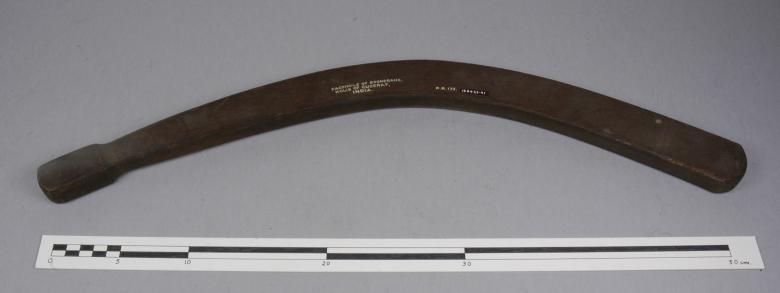
    This text also states that the Koli tribe of Guzerat [Gujarat, North Western India] used boomerangs. We can doubt that the author ever saw himself an indian boomerang as every assertion is attributed to other authors or personnalities or books : Mr Savile Kent citing Mr Balfour, General Pitt Rivers [ex Lane-Fox], Prof. E.C. Stirling, Egerton's "Indian and Oriental Armour", Dr G. Oppert citing the Dewan of Pudukkottai, Mr R. Bruce Foot, G.F. Dr Penha.

    Egerton's "Indian and Oriental Armour" should contain some information about Indian boomerangs, but it is useless on archive.org which refers to googlebooks where (as usual) there is no means to read the thing normally. 

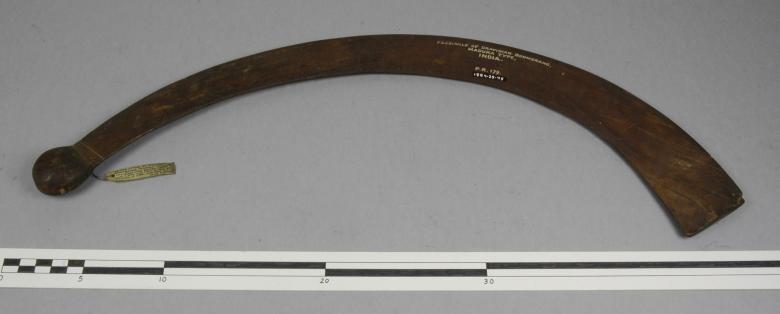
    About Pitt Rivers / Lane-Fox, an interesting article describing his experiments on boomerangs can be read on the Pitt Rivers Museum Web site, at  http://england.prm.ox.ac.uk/englishness-PR-and-Boomerang-technology.html . We learn that Pitt Rivers made several facsimiles of Egyptian and Indian boomerangs seen in museums and that he successfully trained himself to throw them [so, this obsession about boomerangs is at least 130 years old in the west, may be more :-) ]. These are the 2 facsimiles of indian boomerang shown on the Web site (the egyptian one is beautiful also, but not given below) :

    http://england.prm.ox.ac.uk/image-admin/d/2222-4/1884_25_41.jpg 


    http://england.prm.ox.ac.uk/image-admin/d/2226-2/1884_25_45.jpg

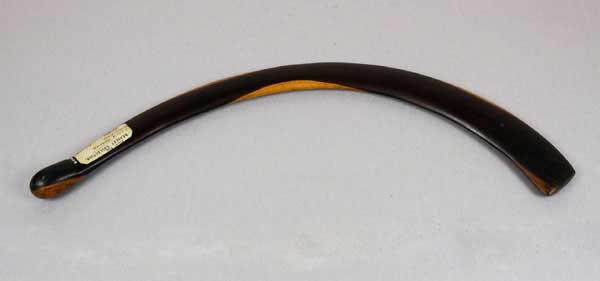
    I can find only another boomerang photo (a ceremonial throwing stick, Madurai, Tamil Nadu) on Pitt Rivers Museum web site :
    http://web.prm.ox.ac.uk/weapons/index.php/tour-by-region/oceania/asia/arms-and-armour-asia-138/index.html


    http://web.prm.ox.ac.uk/weapons/images/joomgallery/originals/asia_3/arms_and_armour_-_asia_20101126_1021464879.jpg


    October 12th 2017 - I find only 2 images (of the same object) in the ROYAL ARMOURIES COLLECTION web site
    https://collections.royalarmouries.org/object/rac-object-10758.html
    "Throwing stick (katariya, birra jungee)", "Dimensions: The length of the weapon is 443 mm (17.5in) max. width 5.7mm (2.0in). Weight: The weight of the weapon is 0.25 kg."; Associated Places : India, Hyderabad. 


    The same one - maybe, although it seems a bit more sturdy  - as photographed in an exhibition of the Royal Armouries;
    found (oct 12th 2017) on http://britseps.blogspot.fr/2012/11/ (toward the end of the post)

    Chennai Museum Web Site only shows a bad quality photo of 2 apparently indian boomerangs but, strangely, the associated commentary is about australian Aborigines (although the comment is not very clear).
    See  this page, which also mentions the Khonds of Orissa without alluding to boomerangs : http://www.chennaimuseum.org/draft/gallery/02/02/ethnolg2.htm
    2018 09 29 : I can't find this web page anymore, but there are now a good number of e-books on the web site of the Museum of Chennai. Some of them mentions boomerangs and valari,
    In the Museum's journal of 1998-1999, there is an article written by a curator named Dr C. Maheshwaran : "Boomerangs in the collection of Chennai state museum". The article cites numerous times 150 years old british information (Thurston, Balfour), which suggests that reliable local information on the subject was not easily found in 1999.
    http://www.e-books-chennaimuseum.tn.gov.in/chennaimuseum/images/books/GOVERNMENT%20MUSEUM%20CHENNAI%20MUSEUM%27S%20JOURNAL%20APRIL%201998%20-%20NOVEMBER%201999.pdf


    In "The races of Man : an outline of anthropology and ethnography", Deniker, 1904 we read that boomerangs named "Singa" are attributed to the Khonds of Orissa [now Odisha, Eastern India] :

    https://archive.org/stream/racesofmanoutlin00deniuoft#page/258/mode/2up


    In "A study of traditionnal throwing sticks and boomerang tuning", Luc Bordes makes an analysis of the shapes and profiles of 5 Indian boomerangs (Valai thadi series of 5 boomerangs from Tamil Nadu) found in the Quai Branly Museum, Paris. See page 6 "a remarkable Indian Valari series" in http://revedeboomerang.free.fr/tuning2.pdf ; figure 12a is reproduced below :


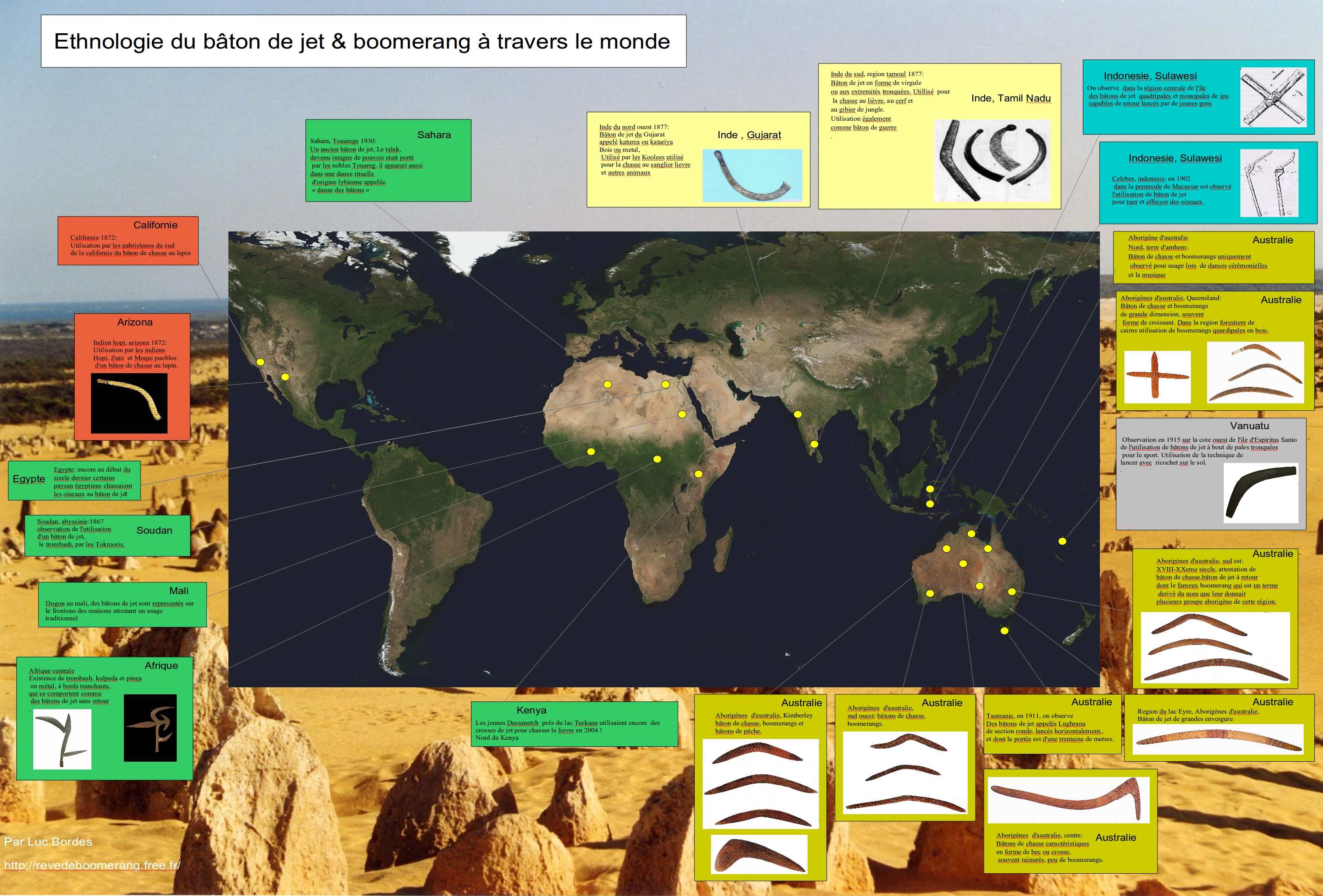
    Elsewhere, on http://revedeboomerang.free.fr/inde.html and http://revedeboomerang.free.fr/planisphere.jpg we find other photos of unknow origin, one is said to represent a Katariya / Katurea (from Gujarat), another represents some Valari and an australian-looking boomerang said to be from Southern India, Tamil Nadu.

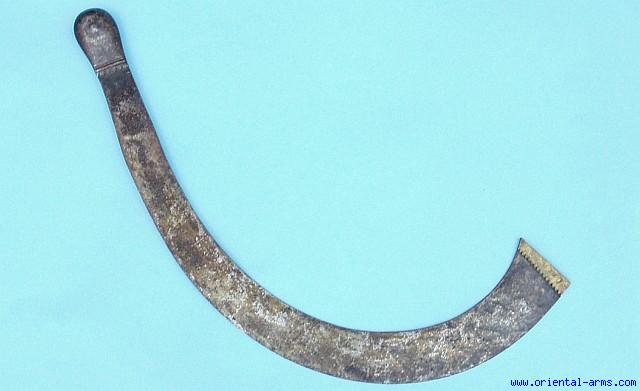
    http://www.oriental-arms.co.il/photos/items/58/000558/ph-0.jpg

    After verification... the first image comes from http://www.oriental-arms.co.il/item.php?id=558 (a sold item). The second one is from one of the editions of  "A glossary of the construction, decoration and use of arms and armor in all countries and in all times, together with some closely related subjects", by . We find in two places (page 346 & 348) the name "Guzerat" as the source of weapons that resemble more to the Tamil's Valari. (wrong attribution ? all mixed up : katari/valari/south india/katariya/gujarat ?) : 


    (Baroda = old name for nowadays Vadodara, third largest city in Gujarat (wikipedia))

    Wilbraham Egerton published in 1880 a catalogue of the collections of the "India Museum" (1801-1879)  : "An Illustrated handbook of Indian arms : being a catalogue of the arms exhibited at the India Museum". Some of the objects were reproduced in this catalog, and among them, some of the Indian boomerangs. We can see a rather well digitalized version of it; and here is a partial map of India where we can see what was called "Guzerat", the territory of the "Kolis", and "Baroda" https://babel.hathitrust.org/cgi/pt?id=hvd.tz1py2;view=1up;seq=8. Extract : 

    I can find only a few mentions of the Indian boomerangs in this publication, and only one illustration; pages 73, 74, 78, 81 :


    Other boomerangs (southern Indian ones), mentioned, but not illustrated (apparently) :


    http://akaalarms.com/wp-content/uploads/birun-21.jpg
    The comments let me wonder if it's a good idea to believe everything ... they seem to be like me : gathering information from every source... I would make every confusion between Katariya and Valari or Gujarat and Tamil Nadu when reading :  "A very rare 18th Century Indian boomerang, traditionally used by the tribes of Gujerat and South India to hunt small animals, and protect livestock from predators. There are various names attributed to these items, Elgood* calls it a ‘Birundungi’ (referring to the South Indian variant); and Lord Egerton**, a ‘Katariya’ (referring to a boomerang used by Koles – a tribe of Gujerat). A lesser known source, Edgar Thurston*** provides some compelling research and calls it a ‘Valari’ or ‘Valai-Tadi’, referring to examples in the Tanjore Museum."


    Another similar object, 30 cm long, steel, called Birundungi, said to be from South India is shown on http://akaalarms.com/sold-south-indian-steel-boomerang-known-as-a-birundungi-ref-10082/


    Another "Katariya" from the Higgins Collection http://www.higgins-collection.org/artifacts/3485

    18 1/4" O.L. 14 oz - Katariya, Gujarat, iron
    http://www.higgins-collection.org/object_photos/artifact_image/image/15344/3485.jpg


    October 12th 2017; found one image on http://ww.w.flight-toys.com/artifacts/tb423.html
    "Iron Singa or Birugundi Boomerang from Southern India"; "Span = 35 cm ; Weight = 238 gm"
    Comment [mostly repeating what we read elsewhere] : "This unusual throwing implement is a Tamil Valari or Birudungi Iron War Boomerang. This example was made out of low grade iron and the surfaces are heavily oxidized, but fully intact and functional. The more common steel form is called the Singa. The form of the Tamil boomerang is of very ancient origin, used in warfare and hunting. The term boomerang which has stuck amongst collectors is purhaps misleading as it does not return to the thrower. All surviving examples share several features in common, the ball or egg shaped knob for gripping, flattened deeply curved body, and a squared flaring end. It was made by the Kallars/Kallan and Maravans (castes / tribes of the Tamil people in South India). These boomerangs were usually made out of wood, ivory or metal. The local name for this type of boomerang is "valai tadi" / "valari tadi" / "vellari thadi" / "vallari thadi" all of which mean "bent stick". It is often a tradition that very fine Birugundi boomerangs were exchanged between brides and bridegrooms."


    October 12th 2017 - A "birudungi" made of steel, presented as
    "Old Indo Persian South Indian Steel Boomerang 'Birudungi" Warrior n Hunting" or "South Indian boomerang"; "Dimension :overall length 35 cm approx", ... 
    Wikipedia says... "Indo-Persian culture" refers to those Persian aspects that have been integrated into or absorbed into the cultures of the Indian Subcontinent. From the presentation of this item, we could wonder whether Persian had boomerangs or steel boomerang. (first quick google searches about that topic didn't retrieve anything).

    (October 12 2017) One image found of a Katariya said to pertain to the Worcester Art Museum ;
    Titled "Katariya (boomerang)" ; origin : Gujarat; made of iron; 46.4 cm (18 1/4 in.), 14 oz (weight) and having small beads inside which make a rattling sound.
    http://vps343.pairvps.com:8080/emuseum/view/objects/asitem/20130/332/invno-asc?t:state:flow=ef4f5ed2-f6fe-4765-8248-92e8b90da8a6


    I first found mention of the Quai Branly collection on this page :
    http://www.ashokaarts.com/shop/extremely-rare-tamil-valari-or-birudungi-wooden-war-boomerang-19th-century where they show another Valari :
     profile and upper face
    Extracts of the comment : "[...] its more common steel form it is known as Singa, it has various names in southern languages: Valari (Tamil), Katariya (Khol), Birra Jungee/Birudungi (Hyderabad), Vălaytădi (malayalam). [...] Similar examples can be seen in the British Museum, Quai Branly, Fitzwilliam and Liverpool Museum amongst others."

    I found nothing about boomerangs on the Liverpool Museum Web site.

    About the Fitzwilliam museum, I was not able to find any photo and their search tool is not very efficient compared to others... it's being replaced... so ... we can at least find a few verbal descriptions for 2 south Indian boomerangs donated by a man named Robert Taylor in 1879  :
    http://webapps.fitzmuseum.cam.ac.uk/explorer/index.php?qu=robert%20taylor&oid=160097
    length: 47.5 cm ; weight: 140 g ;
    http://webapps.fitzmuseum.cam.ac.uk/explorer/index.php?qu=robert%20taylor&oid=160096
    length, 46 cm , weight, 250 g  [shorter but heavier]


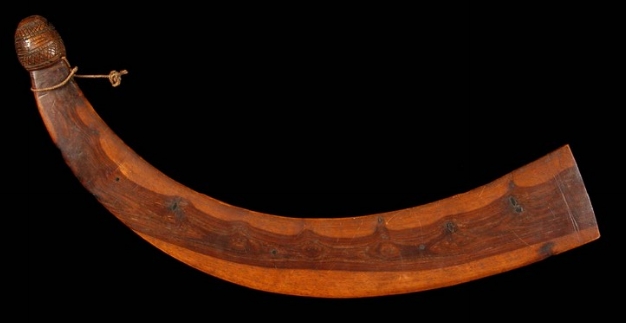
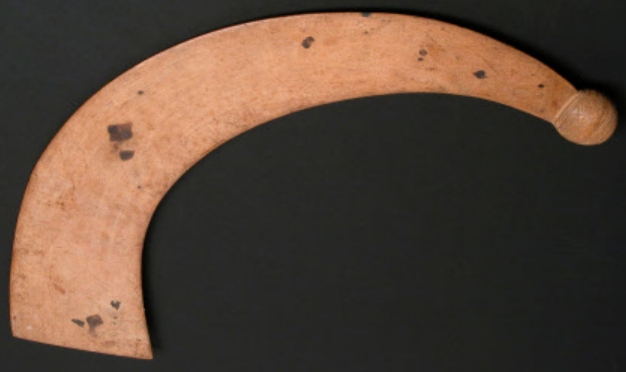
    Quai Branly Museum has a few wooden boomerang not shown to the public, but with photos on their Web Site : http://collections.quaibranly.fr/#71ea5d81-50c8-4054-a2c2-e1fcc19880b7
    (searching for "boomerang inde" we find 4 results, all from South India, Tamil Nadu, Gasivaganga)

    N° 71.1939.85.69 - 16 x 50,5 x 2,7 cm, 114 g 


    N° 71.1939.85.66 - 14 x 48,5 x 2,8 cm, 269 g


    N° 71.1939.85.67 - 17 x 46,5 x 3 cm, 202 g


    N° 71.1939.85.68 - 48 x 15 x 2,5 cm, 182 g


     knobs

    searching for "bâton de jet", we find 2 more boomerangs from India
    http://collections.quaibranly.fr/#15e6b86d-c5d8-4982-9b00-ec0a2511ce1e

    N° 71.1954.21.19 D - 50,5 x 18 x 3,1 cm, 250 g


    N° 71.1950.86.2 - 47 x 14 x 3 cm, 309 g
    [can't be flat, if the data is correct, by comparison with the other boomerangs]


    The British Museum also has some boomerangs from India. Searching for india+boomerang gives 6 results, all named "Valari", one being strange in shape (and doesn't seem to be able to fly).
    http://www.britishmuseum.org/research/collection_online/search.aspx?searchText=india+boomerang

    metal valari from Madurai (?) 34cm x 5.5 cm; 219 g
    http://www.britishmuseum.org/collectionimages/AN01210/AN01210432_001_l.jpg

    ivory valari from Sri Lanka 47 cm x 7.4 cm, 120 g
    http://www.britishmuseum.org/collectionimages/AN01210/AN01210400_001_l.jpg

    ivory valari from Sri Lanka 48 cm x 7.3 cm, 140 g
    http://www.britishmuseum.org/collectionimages/AN01210/AN01210399_001_l.jpg

    wooden valari from Madras 46cm x 7cm, 231 g
    http://www.britishmuseum.org/collectionimages/AN01210/AN01210431_001_l.jpg

    wooden (mimosa) valari from South India 47cm x 6.8 cm, 159 g
    http://www.britishmuseum.org/collectionimages/AN01210/AN01210425_001_l.jpg

    valari, Indian club, from industan (?) 62 cm x 32.5 cm x 3.1 cm ; 480 g [probably not flat and unable to fly]
    http://www.britishmuseum.org/collectionimages/AN01208/AN01208865_001_l.jpg

    Searching for "india throwing stick" http://www.britishmuseum.org/research/collection_online/search.aspx?searchText=india+throwing+stick we find one more boomerang (in shape), this time it is said to have been made by Gond (said to be one of the most diffused tribe in India) but by the shape, it seems to be simply one more valari from south India (with a missing broken angle). 


    6.1 cm, 44.6 cm, 0.2 cm, 0.2 g [the alleged dimensions are clearly false]
    http://www.britishmuseum.org/collectionimages/AN01316/AN01316864_001_l.jpg

    Searching for "collery stick" ("collery" comes from Kallar) http://www.britishmuseum.org/research/collection_online/search.aspx?searchText=collery+stick we find one more southern indian Valari. This one related to : Thanjavur (city, formerly Tanjore), Maravar (Tamil tribe).

    49.5 cm x 6.2 cm; 207 g
    http://www.britishmuseum.org/collectionimages/AN01210/AN01210433_001_l.jpg
    About the "collery stick" we find in "Military reminiscences : extracted from a journal of nearly forty years' active service in the East Indies", James Welsh, 1830, Volume 1, page 130  (https://archive.org/stream/militaryreminisc01wels#page/130/mode/2up) : " [...] taught me to throw the spear, and hurl the collery stick, a weapon scarcely known elsewhere, but in a skillful hand, capable of being thrown to a certainty to any distance within one hundred yards".
    Little more information on the collery-stick / valari that had known James Welsh, on the Web page http://www.sivagangaiseemai.com/maruthupandiyar/maruthu-pandiyar-history6.html# (about the history of Maruthu / Marudhu / Mardoo brothers once rulers of Sivagangai) The text seems to replicate parts of James Welsh's text without always saying it, so it's not very clear where the information comes from). 
    From the blog Maya Devar comes another photo that spresents a dozen of Valari : http://mayadevar.blogspot.com/2009/04/poomarang-valari.html . By interpreting the automatic translation of the Tamil comments, I guess those Valari were exposed in the palace of the ex-ruling family in Ramanathapuram / Ramnad, South East India.
    We can guess that most of those valaris are only slightly flattened : except the one in the center ; they may have been unable to really fly. 4 are broken in a way that let think they were not perfectly cut along the grain of the wood. Maybe because, for handiness, the knob had to diverge slightly from the overall  curve.
    https://blogger.googleusercontent.com/img/b/R29vZ2xl/AVvXsEiJdaiBBG-84HI8IySZX1XxFo8IbLJTXYph4sqDEaqsUkTAe9hNUF-pKRH2ckx09XjYM1hlVzfFIYTnPd1qmR_CE0wQOelM-lCQbajV7VUZ8TjN8nlX0WbeAdIXnPedl1dSCIFJNh9a56E/s1600/pumarang.jpg


    On http://tamilnation.co/heritage/weapon.htm we find another article about boomerangs used by the Tamils (but no source is cited) : "Valari - An Unique Weapon of the Tamils". The url "tamilnation.co" is said to replace temporarily "tamilnation.org", so be sure to go there when this url doesn't work anymore. And there is an image of a valari that is said to have been found in Thondi (city, port, in Ramanathapuram District, Tamil Nadu). Associated person names : Dr Jeyachandrun (the man who holds the valari in the photo), Dr Jayabarathi (the author of the article)
    http://tamilnation.co/images/heritage/valari.jpg


    On http://vikingsword.com/vb/showthread.php?p=56083 we find two photos.
    The first one is of a metal boomerang, from the book of Robert Elgood (2004) "Hindu Arms and Ritual: Arms and Armour from India 1400-1865" where it is said to be on page 191 (also said : more boomerang from India to be seen on page 193 ; the author states that there are 6 types of boomerangs in India - [can't verify that, this book is too recent to be freely read online] ).
    http://vikingsword.com/vb/attachment.php?attachmentid=25675&stc=1

    The second one is said to be from a "book Malbourough House" (I found on archive.org a catalog of "A CATALOGUE OF THE MUSEUM OF ORNAMENTAL ART AT MARLBOROUGH HOUSE PALL MALL (1856)" but there is only the part I ; the Division 14 - about weapons - may be in the second part; see it at http://hdl.handle.net/2027/chi.80791435). The photo represents a cluster of weapons labelled "CASE J". I show here only the #205 : something shaped as another ivory boomerang from India.
    http://vikingsword.com/vb/attachment.php?attachmentid=26571&stc=1


    A few more boomerangs found by searching "throwing weapons" in the National Trust Collections (after having seen photos and detailed comment on Pinterest)  http://www.nationaltrustcollections.org.uk/search/1?show=100.
    http://gateway.ntpl.org.uk/hppa-zooms/00000000420/cms_pow2614.bro
    http://gateway.ntpl.org.uk/hppa-zooms/00000000420/cms_pow2615.bro

    http://gateway.ntpl.org.uk/hppa-zooms/00000000621/cms_pow2616.bro

    http://gateway.ntpl.org.uk/hppa-zooms/00000000621/cms_pow0304.bro

    http://gateway.ntpl.org.uk/hppa-zooms/00000000419/cms_pow2435.bro


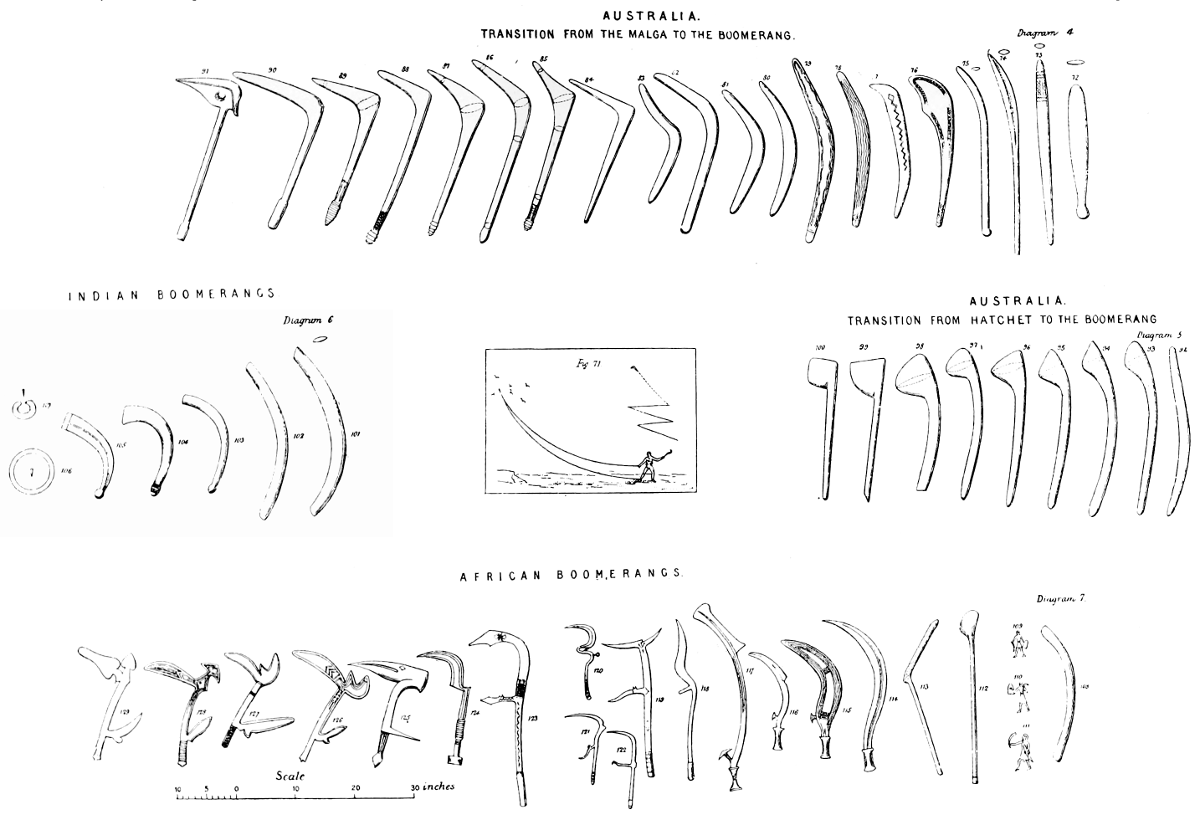
    "The Evolution of Culture and Other Essays", Pitt-Rivers, Augustus Henry Lane-Fox, 1906
     Plate XV, diagram 6, Indian Boomerangs
     
    There may have been an interesting collection of Indian boomerangs at the Pitt-Rivers Museum in 1946; Large enough to deserve a catalog (?), from what we may infer from "Sir Francis made a valuable catalogue of our Indian boomerangs" (see the annual report of the curator of the Pitt Rivers Museum, in 1946, http://web.prm.ox.ac.uk/sma/index.php/museum-annual-reports/246-1945-46-annual-report.html )


    46.8 x 5.2 x 2.5 cm, rosewood, blades shod in silver, heavy knobs
    Presented by H.H. The Rani of Shivaganga, Mysore

    49.3 x 15.2 cm, rosewood, flat blade, iron band, heavy knob
    Presented by H.H. the Rani of Shivaganga, Mysore

    48 x 15 cm, rosewood, flat blade, iron band, heavy knob
    Presented by H.H. the Rani of Shivaganga, Mysore


    Singhá, 44.2 x 14.5 cm, flat [?? doesn't seem so] steel blade, heavy knob
    Presented by H.H. the Rani of Shivaganga, Mysore


    Singhá, 44.0 x 14.6 cm, flat [?? doesn't seem so] steel blade, heavy knob
    Presented by H.H. the Rani of Shivaganga, Mysore


    38.8 x 15.5 cm, flat steel blade, heavy knob
    Presented by H.H. the Rani of Shivaganga, Mysore
    Singa, 39.5 cm, flat blade, heavy knob
    Presented by H.H. the Rani of Shivaganga, Mysore

    43.3 x 17.0 cm, flat steel blade, heavy knob, N° 38589
    Presented by H.H. the Rani of Shivaganga, Mysore


    46.0 x 5.2 x 2.9 cm, flat rosewood blades, heavy knobs, N° 38129
    Presented by H.H. the Rani of Shivaganga, Mysore


    2 Singá, 34.8 x 14.8 x 2.4 cm, silver-damascened steel, flat blades, heavy knobs
    Presented by H.H. the Rani of Shivaganga, Mysore


    45.7 x 6.4 x 3.2 cm, ivory boomerang, each side slightly convex
    Presented by Ramachandra Tondaiman, Raja of Pudukkottai.


    54.2 x 10.6 x 2.1 cm, ivory, slightly convex surfaces, tapering to flat rounded pommel,
    fitted with band mount at wide end
    Presented by Ramachandra Tondaiman, Raja of Pudukkottai.

    36.4 x 4.8 x 2.6 cm, coloured ivory with strong grain, silver and lacquer


    "Handbook to the ethnographical collections", British Museum, 1910. Found on archive.org :  https://archive.org/stream/handbooktoethnog00brituoft#page/48/mode/2up

    (This comment differs from what we understand from http://revedeboomerang.free.fr/planisphere.jpg, where an australian looking boomerang and 3 southern indian boomerangs are all related to Tamil Nadu)


    The Rough Guide to South India, https://books.google.fr/books?id=sEhJBfbhTAAC, page 513
    [...]

    That is probably related to the mayadevar blog entry seen earlier.


    The Hindu, April 22, 2012


    Update, oct 2015 : 
    I'm happy to see the above text reproduced (under the title " Maravar Wepon Boomerang collected in Maravar Zamintaris" ... what is Zamintaris ?) on
    The two copies have added something : a link to "chakra(boomerang)" from the "Book of Vishnu" by Nanditha Kirshna. As far as I understand : in some mythical/religious stories and books of India, some gods and supernatural creatures made use of a weapon called "chakra" that had the property to come back in the hand of the thrower; the article makes a link with neolithic boomerangs.


    Found this picture of beautiful Indian boomerangs on a facebook group organised by someone named Raniganda Ranganathan and promoting the revival of the Valari : தமிழர் வளரி 2016 (Ancient Boomerang)

    https://www.facebook.com/photo.php?fbid=1069700086383165&set=gm.1069205826464851&type=3&theater
     [the one on the right side seems more australian (?)]


    On the same facebook group, someone (Kamala Balchandar) posted this picture, said to be of a family bringing home natural mangrove elbows (supposedly for making boomerangs).

    https://www.facebook.com/photo.php?fbid=1047058982012520&set=gm.944731938941785&type=3&theater


    TheHindu.com has an article (dated june 3 2016) about valaris : "The deadly weapon that exemplified Tamil spirit". (http://www.thehindu.com/news/cities/chennai/the-deadly-weapon-that-exemplified-tamil-spirit/article8684011.ece)

    According to this article, there may be lots of information to be read about valaris : " 'A lot of British documents of the 17th and 18th century talks about the weapon' said Sahitya Akademi award-winning writer Su.Venkatesan, who has done a lot of research about the weapon.". The same Venkatesan is said to have seen hundreds of Valaris in a temple in Kovilankulam in Madurai where valari was still offered to a deity named Pattasamy. The article shows a photo with a comment saying that it depicts valaris as an offering to Pattasamy.
    Another interesting claim, in part attributed to a man designated as "IAS officer M. Rajendran" : the British would have banned the use of valaris in 1801, and even recollected and destroyed 15000 valaris.


    James Hornell
    The Journal of the Royal Anthropological Institute of Great Britain and Ireland
    Vol. 54 (Jul. - Dec., 1924), pp. 316-346

    The section about boomerangs seems much less documented and precise than that of the blow-gun. But the content seems plausible (to the basic ignorant; when he ignores the seemingly wild speculations about links with Egypt and Egyptian boomerangs). 

    We read that non returning boomerang were still in use in India in ~1920.  There is also a mention of the use of thin returning boomerangs.
    A glimpse at the original text above cited (Lane Fox Catalogue, page 28; https://babel.hathitrust.org/cgi/pt?id=umn.31951002133997g;view=1up;seq=52) shows nothing very fascinating (lots of speculations about the possible evolution of the boomerang), no much real indian boomerangs, 3 fac-simile. The assertion that some Indian boomerangs can be made to return may well be the result of his practice with fac-simile, not the result of him witnessing South indian individuals using their traditional boomerangs in this way.

    The tradition seems rooted in the past, if we believe the remark that tales about heroic skilled throwers were appreciated.

    In ~1920 the boomerang was mainly used for hunting.


    Here are the figure of the boomerang Hornell found in a the Ramnad district 


    A short YTB video 
    by user "mohamed rafeek" showing some beautiful exemplars 
    "boomarang valari kambu of tamilnadu once used by maruthu brothers"


    The term "valari kambu" is rarely seen elsewhere on the internet and seems related to Sivaganga Palace.
    The mentions I found (often mere copy/pastes) :
    • once here : http://www.sivagangaiseemai.com/history/sivagangai-kingdom.html
    • once here : http://www.discoveredindia.com/tamil-nadu/attractions/historical-and-archeological-places/sivaganga-palace.htm
      • same thing here : http://www.thehindu.com/todays-paper/tp-in-school/of-valour-and-victory/article4953775.ece
      • and here http://tamilnadu-favtourism.blogspot.fr/2016/08/sivaganga-palace-sivaganga.html 
      • and once again duplicated here http://www.skyscrapercity.com/showthread.php?t=1467658&page=21 
      • an again (a small excerpt) here http://shodhganga.inflibnet.ac.in/bitstream/10603/149560/10/10_chapter%204.pdf


    From the V&A web site

    Boomerang made in Gujarat, wood, Length: 68.6 cm, Width: 4.7 cm max; made in ~1850
    http://collections.vam.ac.uk/item/O1289532/boomerang-unknown/

    Another one, made in Gujarat, Length: 74 cm, Width: 6 cm max.
    https://collections.vam.ac.uk/item/O1289531/boomerang-unknown/


    We can find interesting keywords in the notes : Kole tribe, hunting game, katariya, katureea
    • "As originally arranged and displayed in Exhibition Road Indian Museum galleries until 1955, with some additions while in storage, case F.695"
    • "Carved wooden boomerang with inscriptions in black ink on one side, used by the Koles for hunting game, Gujarat, mid 19th century. Ex India Museum. Egerton 2.; boomerang, katariya; Arms, wood, Gujarat"
    • "Boomerangs katureea: (three); wood, undecorated; length on outer curve 34, 29, 29 ins; Kole tribe, Gujarat2761 I.S. [pre 1993]"
    • bibliographic reference : "Lord Egerton of Tatton, Indian and Oriental Armour, London, 1896, p. 78, Cat. No. 1-3"


    From the National Portal & Digital Repository of the Museums of India
    a boomerang from the Salar Jung Museum, Hyderabad
    (almost no description : wood; 46.0 H; origin = North Eastern India (doubtful ? resembles too much to a south Indian valari) ; irrelevant comment about Australian boomerangs)
    June 9 2018 : A search for "boomerang" across all museum retrieves only this result.
    Exact searches for "valari", "valai thaddi", "valai thadi", "katureea", "katariya", "singa", "birudungi", "birundugi", "kollery", "collery", "throwing stick", "throw stick", "rabbit stick" retrieve nothing, or nothing resembling a boomerang.

    From a  video ("Maṟakkappaṭṭa vaḷari") in Tamil language about Valaris, showing mostly metal ones:
    Maṟakkappaṭṭa vaḷari

    2 photos posted on https://twitter.com/ThanjaiMadhavan  (an account focused on archaeology) apparently taken in a museum in Thanjavur, Tamil Nadu (Thanjavur Royal Museum ?). No much new information in the tweets as far as the automatic translation goes (weapons used againt the British by the Maruthu Pandiyar brothers ) and maybe 1 precision I did not notice before : the name of a commander - வைத்திலிங்க தொண்டைமான் / Thondaiman.
    and a close up on one of the valaris :

    From https://twitter.com/Nellai_MARAVAN 
    one photo - that may be from the same museum as above  (Thanjavur Royal Museum ?) and even may represent the exact same valaris as above, but arranged differently at another time , with other artifacts including 2 more valaris -  in the tweet 

    and another one, in a tweet mentioning the Kallar and Marawar comunities in Sivagandai and Ramanathapuram. Maybe the place of origin can be read, under the objects represented, by people understanding Tamil language. 


    From a blog about the Kallar clan history 
    2 photos of Valaris, in a post http://kallarkulavaralaru.blogspot.com/2018/05/blog-post_3.html about a Thondaiman family of rulers in Tamil Nadu (as far as I can understand from the automatic translation of the very few explanations that are given on this blog. 
    The post is mainly a series of photos with almost no comment. 
    So, we won't know were the photos were taken. They represents a showcase that may not be focused only on Tamil weaponry, as we can see a Australian-looking boomerang, and a primitive-looking bow.
    Actually it's probably the same showcase partially shown on Raniganda Ranganathan's facebook page (see higher) and his photo mentions  Pudukkottai Museum.


    Note the Australian-looking boomerang in the lower part of the showcase.


    A Thanthi TV video (sept. 2018) about valaris in Nellai Museum :   https://youtu.be/dLemfXCxdOw


    Images - 2019 - of metal valaris from Kovilankulam, already mentioned previoulsy  :

    - in the video https://youtu.be/Ai45UAXEtRU ,  posted on Youtube channel "Pitchappan Ramaswamy", in 2019. The australian boomerang champion Roger Perry encounters Virumandi, the "first indian" (his DNA has the 70.000 years old gene-marker M130, typical of the african migrants to india, east asia and australia); then he visits the temple to see the valari.


    - in a video inserted directly into the blog (not found on Youtube)     https://kallarkulavaralaru.blogspot.com/2019/04/blog-post_13.html ; the video refers to the same event (Roger Perry visiting the temple). We see Perry guessing the distances to which he would be able to throw various of the valari. (But... no tests... the valari seem to be respected objects, not to be used).


    About wooden valari... 

    Until 2019, I've read lots of comments from people saying that valari were only made from metal.
    We can find 2 recent (mid 2019) videos from youtube channel "Pandiya Rajan" where old wooden boomerangs are shown and manipulated (but not thrown).

    - drawing the contour of an old wooden valari : 


    - showing the size and shape of one (or more) old wooden valari : 


    Valari in old stone carvings 
    (no scientific datation, i guess)

    Several carvings featuring warriors holding a pair of valari are shown on Youtube channel 
    "மாமன்னர் சிலம்பக்கூடம்". The description, by Khartik Raja, a boomerang/valari player, indicates that the location is near Karumathoor, Madurai.


    Modern usage of valari for hunting

    We can read that “Today, many in Madurai and Ramnathapuram, in parts of Thanjavur, Tirunelveli and Pudukottai indulge in hunting using the boomerang. We find that vellalas, valliyans, nadars and Muhammadans using it, though of course, less than maravans and kallars, with whom it is particularly identified,”

    in : https://timesofindia.indiatimes.com/city/chennai/tracing-the-tamil-boomerang-connection/articleshow/71946275.cms

    The statement is attributed to Lily Bhavna Kauler, an Indian researcher based in Australia, focused on aboriginals in Australia and tribal people in India. Maybe the statement contains some transcription error... Or maybe it is entirely correct and we would like to see that ; i found nothing for now...  except a joint interview with Roger Perry, where Lily Bhavna Kauler says she has been researching about the Indian boomerang for the last 20 years... so she may have a lot of information to share.


    Valari, their flight,  2 types of indian throwing sticks

    I had overlooked some of Luc Bordes' papers (on researchgate.net, if you can get there, or on revedeboomerang.fr).

    We find, in his Master thesis, 2014, "The prehistoric throwing sticks and their representation" (http://revedeboomerang.free.fr/Master thesis - Throwing sticks -Luc Bordes2014.pdf  or in french  http://revedeboomerang.free.fr/memoire-LucBordes.pdf ) :

    2 types of Indian throwing sticks, that the current literature doesn't help much to differentiate :
    "The series of Indian artefacts presents two main types of throwing sticks known to this region of the world, with a majority of throwing stick called "Valari" (see Appendix I) from the southern part of the subcontinent. The functional information depend from too general information that does not differentiate symmetrical throwing sticks used in Gujarat by Koles, from the "Valari" used by Tamil, yet a very different type."

    The valari should flight straight 
    "The Valari belong to the class of asymmetric throwing sticks with broadened blade blade, an optimum shape commonly used also in central Australia. Their distinguishing attribute is a ball-shaped handle which reduces the aerodynamic lift by rotation breaking of the attacking of handling blade aiming to constrain these projectiles to a straight trajectory. The other main type of throwing stick encountered is that used by Koles peoples in Gujarat (Lane Fox, 1868) belonging to truncated crescent-shaped symmetrical class."

    We find images of 2 wooden valari reinforced with metal strips, in an article of ExArc (Experimental Archaeology) journal, 2015. The article describes an experimental study of a Gaulish boomerang that also had metal strips. (https://exarc.net/issue-2015-3/ea/gaulish-throwing-stick-discovery-normandy-study-and-throwing-experimentations)

    Copy of "Fig 14a and 14b. Example of valari showing the two different types of iron strips encountered: a wide welded iron strip at the short following blade extremity and several narrower repair strips fixed with rings (Pitt Rivers Museum, Oxford UK)"


    Copy of "Fig 13a and 13b. Valari carefully finished with an iron strip at the end of the following blade. Width of strip is 24 mm, thickness 1 mm (Pitt Rivers Museum, Oxford UK)"


    About how to use the weapon (and what it was made of)


    2020 07 29 - I read in Castes and Tribes of Southern India, E.Thurston quoting other people.

    http://www.gutenberg.org/files/42991/42991-h/42991-h.htm#xd21e927
    [Castes and tribes of southern India, volume 1, preface xxix] :
    "Of the so-called boomerangs of Southern India, the Madras Museum possesses three (two ivory, one wooden) from the Tanjore armoury (Pl. II). Concerning them, the Dewān of Pudukkōttai writes to me as follows. “The valari or valai tadi (bent stick) is a short weapon, generally made of some hard-grained wood. It is also sometimes made of iron. It is crescent-shaped, one end being heavier than the other, and the outer end is sharpened."
    [made from various materials]


    http://www.gutenberg.org/files/42993/42993-h/42993-h.htm#pb71
    [Castes and tribes of southern India, volume 3, page 71] :

    "Men trained in the use of the weapon hold it by the lighter end, whirl it few times over their shoulders to give it impetus, and then hurl it with great force against the object aimed at. [...] experts [...] could at one stroke despatch small game, and even man.[...]"

    [nothing is said about the capacity of making a valari return to the thrower; and the notion of whirling a boomerang a few times to give it impetus is strange... i would say : probably erroneous]

    http://www.gutenberg.org/files/42995/42995-h/42995-h.htm#pb47
    [Castes and tribes of southern India, volume 3, page 47] :

    "I had an opportunity of seeing these boomerangs in use near Sivaganga in March, 1883. In the morning I came across many parties, small and large, of men and big boys who were out hare-hunting with a few dogs. The parties straggled over the ground, which was sparsely covered with low scrub jungle. And, whenever an unlucky hare started out near to the hunters, it was greeted with a volley of the boomerangs, so strongly and dexterously thrown that poor puss had little chance of escape. [...] Whether a dexterous Maravar thrower could make his weapon return to him I could not find out. Certainly in none of the throws observed by me was any tendency to a return perceptible. But for simple straight shots these boomerangs answer admirably."

    [again, no testimony about the returning capacity; on the contrary : efficient for straight shots]


    2020 10 09 - photos of old wooden and iron valari revered in religious setting (if i understand the automatic translation of the text). Found on the facebook page of a "History Museum".

    another excellent one, looking even older and more primitive

    iron valari, in the same type of setting


    2021/04/12 The boomerangs from India do not return... This is the conclusion of an article from S.Davidson : "Is The Boomerang Oriental ?", published in 1935, in the Journal Of The American Oriental Society, Vol.55. See page 174 to 176 in https://archive.org/details/in.ernet.dli.2015.531161/page/n187/mode/2up
    In this article, the author cites Hornell (see higher) and Lane Fox; asserting that even Lane Fox (who once wrote that he had made some Indian boomerangs to return) finally recognized in 1883 that the boomerangs from India were not designed to return and did not return.

    2021/11/14 
    A wooden valari and an iron valari from (?) Tirunelveli district museum, shown on ytb channel MHCRF; interesting particularly, because we see a hand holding those valaris : gives a good estimation for the size. The iron valari seems pretty small... should not prevent it from doing some damages, as a weapon. See the MHCRF's video here : https://youtu.be/r7L6_9DCFi8

    wooden valari tirunelveli district museum


    2021/11/14 
    2500 years old cave art representing a valari, in Aundipatty (Madurai, Tamil Nadu); see the ytb video from Thanti TV, here : https://youtu.be/7NmzBgsdWlE


    2021/11/14
    ancient stone sculpture representing a warrior with a valari, in E.Kottaipatty, near Usilampatti, Madurai, Tamil Nadu; see the video from ytb channel India 10 news, here https://youtu.be/LMhESMIOGl4 ; and a longer video from ytb channel Mathi Vanan, with explanations (in Tamil) about art and archaeology, here : https://youtu.be/OtCNQsxWgj4